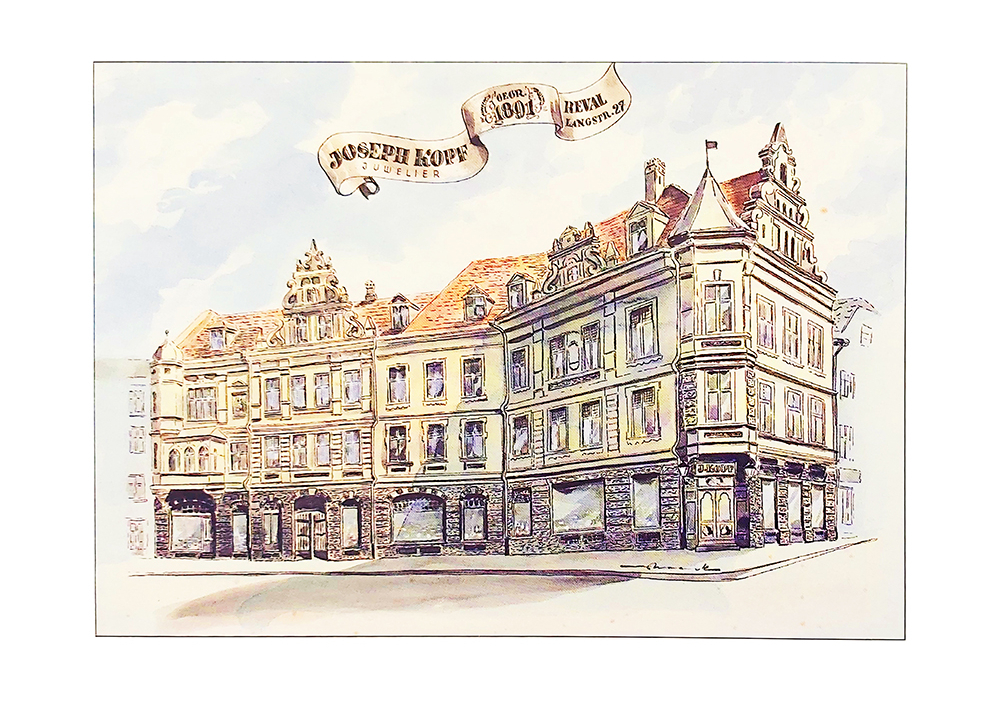

The building at 2 Hobusepea Street was built by goldsmith Joseph Kopf (1867–1930). Descended from a German family, Kopf trained as a goldsmith under Johan Julius Stamm in Tartu from 1881 to 1885 and later travelled to St Petersburg as a journeyman. In 1891, he opened his own goldsmith’s workshop in Tallinn’s Old Town. Before the Second World War, Kopf’s company was well known in Estonia, producing both silverware and unique commissioned pieces.
The building at 2 Hobusepea Street was completed in the same year, 1891, and housed the company’s workshops, office and showroom, as well as the Kopf family’s living quarters. During construction, the street-facing wall was initially left open so that a heavy stamping press and rolling mill could be lowered into the basement. Only then was the façade completed. Remarkably, the stamping press, now well over a hundred years old, is still in use today.
In the winter of 1925, Kopf’s shop was the scene of one of the largest robberies in Estonia during the interwar period. The shop window facing Hobusepea Street was smashed and jewellery worth one million marks was stolen. The perpetrators were never caught and the jewellery was never recovered. After the robbery, Kopf began locking the most valuable pieces from the shop windows in the safe overnight.
The large iron door of the safe on the ground floor required two keys to open – one was held by the shop manager and the other by Kopf himself. A smaller safe was built into the floor of the main safe, although it has not survived. During the Soviet-era Art Products Combine, the main safe was used to store precious metals and gemstones.
Under Soviet rule, Kopf’s company was nationalised, but work continued in the Hobusepea Street building as part of the Art Products Combine. Many former employees remained, and the second floor housed the so-called “gold room”, where gold jewellery was made.
Today, the building at 2 Hobusepea Street belongs to the Estonian Artists’ Association, and its rooms and historic equipment preserve a remarkable part of Estonia’s jewellery-making heritage.

