





RING
Tiina Rajakallio
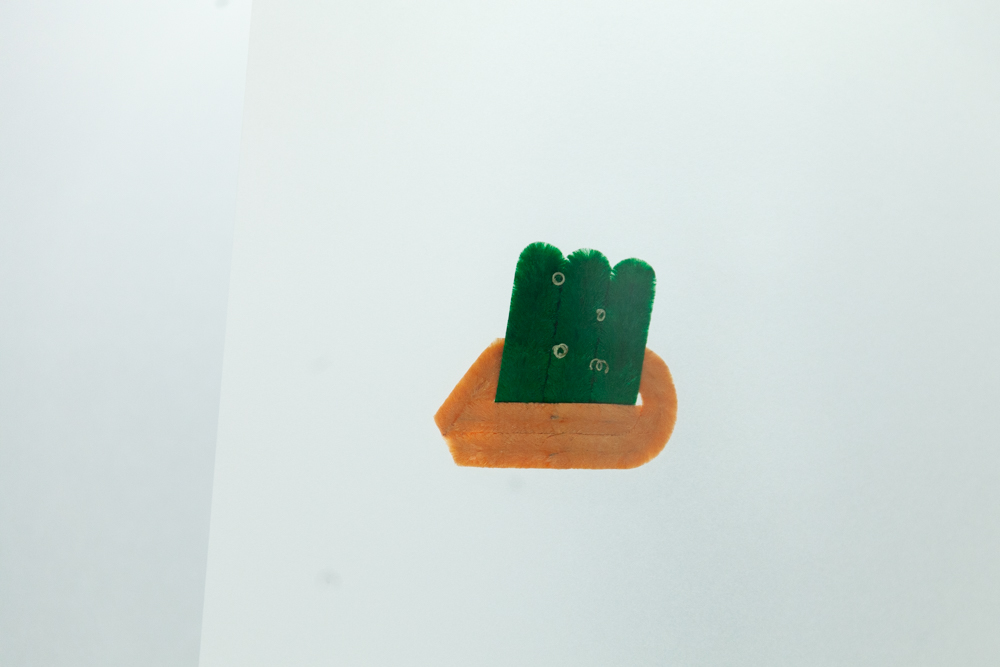
The starting point for Rajakallio’s project was to find her own style of using the marquetry technique in jewellery, combine it with other techniques and see how her work fits in the long history of the tradition of marquetry. Marquetry is a veneer decoration technique traditionally used in furniture and room decoration. Wooden veneers are used to form a mosaic-like image by combining different wood species and utilizing the unique patterns of the wood. In Europe, the technique became popular in the Renaissance period in Italy, where it served both secular and ecclesiastical goals as a fashionable phenomenon of its time. In autumn 2019 Rajakallio spent a three-month residency period at Villa Lante, the Finnish Roman Institute and started this project.
At the beginning, the imagery of the works was referring to what Rajakallio had seen and experienced in Italy. Gradually the work started to become timeless descriptions of life in general. The ideas of the work arose from the author’s personal experiences and reflections, but with the aim to reach something general. The past few years have been very special to us. We are facing many global issues and insecurities and they affect us. The pieces tell about the cycle of life and different aspects of humanity. They reflect on how we are with others and what kind of mark we leave on our environment. On the display of the exhibition, a large golden circle shines behind the works. That and the name of the show “Ring” can be seen as a reference to the cycle of life, the sun, eternity or the halo. Everything is interconnected and the movement never stops.
Rajakallio’s works are picture plates that you can carry and wear. Most of them can be worn as pendants or brooches. The pendants have simple silver rings at the back, of which the piece can be hung around the neck with a ribbon, the brooches have a simple brooch mechanism for attaching to clothing. Some of the works have engraved, burned or stained details. The series also features crocheted yarn and carved wooden pieces. This is a selection of the series that consists of 40 pieces. The works have been finished in 2021-2022. The Arts Promotion Centre Finland has supported this project along its way.
Tiina Rajakallio is a Finnish jewellery artist currently living in Lappeenranta, Finland. She earned her master’s degree from a metal department of Konstfack, University of Arts, Crafts and Design, in Stockholm, Sweden in 2008. The Bachelor Degree she received from South Carelian Polytechnic Lappeenranta, Finland in 2005 studying stone object and jewellery design. Rajakallio is active in associations and projects of her professional field and serves as the chairwoman of Southeast Finland Designer Makers TÄKY. Previously, she has worked as a part-time jewellery teacher. Today, Rajakallio works full-time on jewelry art and small series jewelry in her studio in Lappeenranta and presents her work in exhibitions internationally. Rajakallio’s works can be found in international private collections as well as in the CODA Apeldoorn museum in the Netherlands, the collection of the Finnish State Art Commission and the collection of the Finnish Jewellery Art Association.
UMSWENKO
Khanya Mthethwa
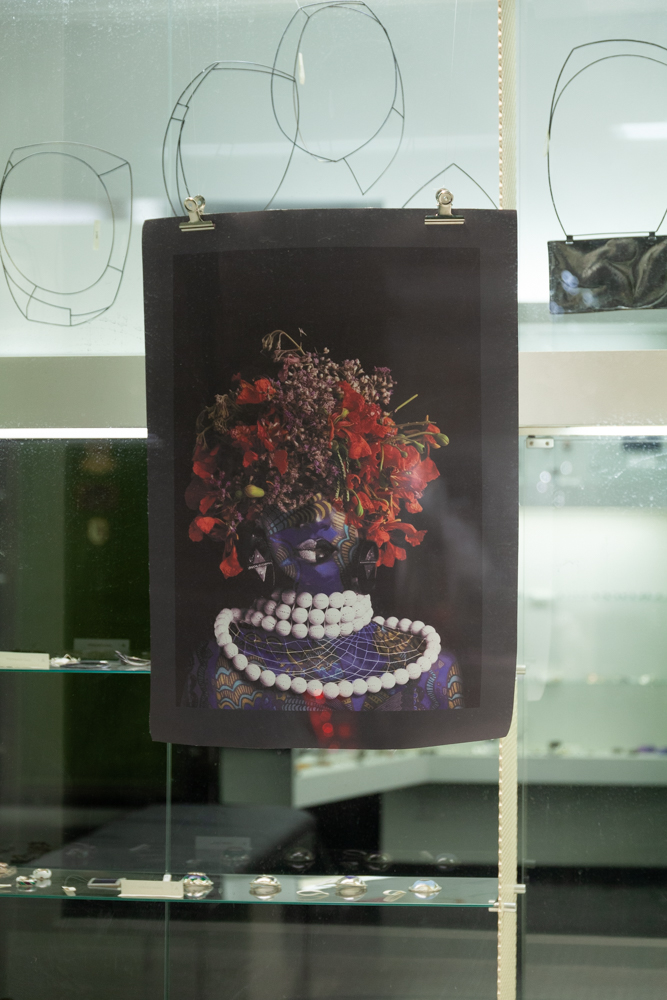
The collection is titled Umswenko – how as indigenous people we confidently present ourselves to the world through cultural adornments as identification. The work moves beyond the concept of jewellery and body painting as just adornment. For this work the artist combines elements from Zulu, Ndebele, Suri ethnic groups and the West African Ankara fabric, which have similarities with body paintings/adornments or wall paintings using specific motifs to preserve visual culture identifiable with each ethnic group. The way people adorn themselves is embedded in the way we see and think of the body.
Suri and Zulu women make use of clay for protecting their skin against the sun and as a representation of clay, makeup and white ochre are used in the portraits. Ndebele and Ghanaian people make use of patterns and textiles on fabric and their walls as artistry that serves as group identification symbols. The repeated rhombus shape represents patterns found in the Zulu beadwork on the 3D printed and handwoven jewellery. The 3D printed beads and necklaces represent the ability of ethnic groups to adapt and develop with times despite the colonial influence on the ways of dress. How Suri people use clay on their bodies to create decorative patterns is represented by the Ankara fabric superimposed on the body as body paint. As indigenous people, our bodies are part of an identity that is layered with materials, evoking a sense of belonging and an association with cultural practices.
The artist’s work looks at how jewellery does not stay the same because it changes in every cultural context. Today technology becomes part of a cultural context where mass production takes precedence over handcrafted jewellery. Umswenko combines aspects of the digital with rediscovered history. Motifs found in indigenous groups which are 3D printed inspire the designs, combined with weaving techniques that simulate the skills used in jewellery and indigenous groups to create adornments. The weaving symbolizes the multiple and layered history of indigenous groups, and how this becomes part of material culture.
Umswenko collection is a visual representation of how jewellery, body painting and adornments can stand as an art form that transmutes in every generation.
This work is a celebration of different indigenous groups and an invitation to the onlooker to view the indigenous being not as the ‘other’, but as a being that evolves and one that chooses how to present itself to the world. The Zulu people are not just spears and animal cloth. The Suri are more than flowers and body painting. The Ghanaians are more than Ankara fabric. Wall art and neck rings are not the only things the Ndebele are. As indigenous beings we are not subaltern but we too think, imagine, create, grow and exist in this space and time. From Ghanaians adopting Ankara fabric after the Dutch introduced the fabric to them, Zulu people adopting beads through trade and making it into their own identity signifier, to the Suri resisting any external influence on their culture- the colonized being finds a voice and uses colonial influence to express a new identity without the absence of trauma but an acknowledgement of history. I invite the viewer to not gaze at the images as a continuation of a colonial gaze, but to see the beauty of being human. I invite the viewer to take an interest in the significance of cultural adornments in order to gain intercultural understanding.
Khanya Mthethwa is an award winning jewellery designer that was born in Kwa- Zulu Natal, currently working as an academic at the University of Johannesburg. Some of her prominent accomplishments within academia include a Masters of Art in the field of design, Rough Diamond Evaluation and Diamond cutting certificates. At the present moment she is also a PhD candidate at the University of Johannesburg in the department of Visual Art majoring in Art History. When she is not immersed in her studies and lecturing, she takes on the role of founder and CEO of Changing Facets – a company that specializes in contemporary, wearable art jewellery that draws inspiration from indigenous cultures within the African continent. She passionately advocates for the growth of jewellery in the country, and has since become the driving force behind the establishment of the South African Jewellery week event which is notably the first platform of its kind in the country. The event aims to provide and garner the attention of potential clients for designer’s.
THE GARDEN
Muyang Li
The Garden series is an exploration of the craft of Velvet Flower. It’s a traditional headdress craft, mostly used to make for courtly headpieces. However, the grand and complicated hairstyles with gorgeous and ornate velvet flowers are obviously no longer in line with the contemporary daily needs.With the widespread use of media, traditional culture has been revived and this fading craft was able to return to the public eye. But it is also deeply bound to vintage clothing.
Complex monoliths composed of a large number of repetitive elements characterize velvet flowers. By analyzing and reorganizing I hope to explore the expressions and more possibilities that are applicable to the contemporary context.
The traditional velvet flower is an extreme use of silk, presenting the authenticity of the plant in various forms. The Garden series is a tribute to tradition. At the same time, it also liberates the velvet flower from the simulation. The charm of color and material can be felt more directly without the constraints of figurative forms.
Muyang Li has studied in Central Academy of Fine Arts (CAFA) in Beijing, China and is currently finishing her Master’s degree in Estonia Academy of Arts(EKA),Tallinn, Estonia in Master of Jewellery and Blacksmithing. Her works have been exhibited in China, Netherlands, Gene Town and Tallinn.