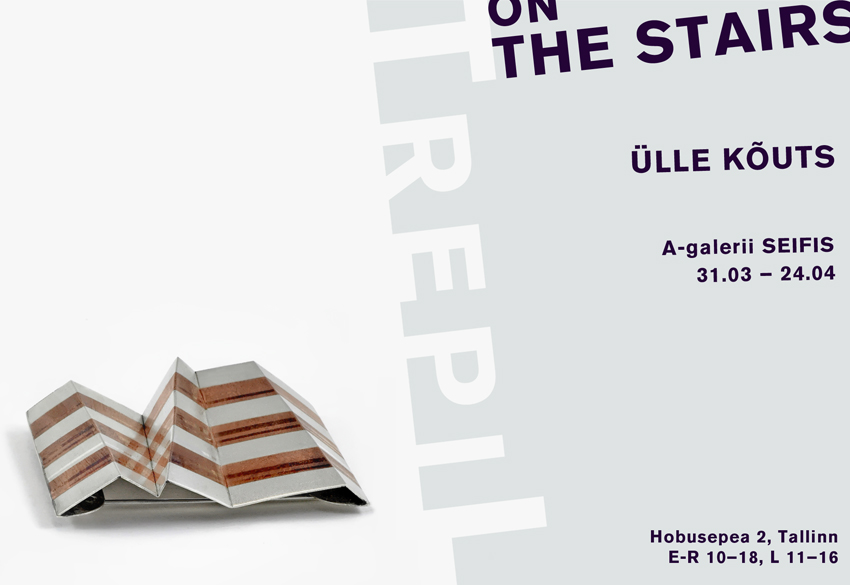
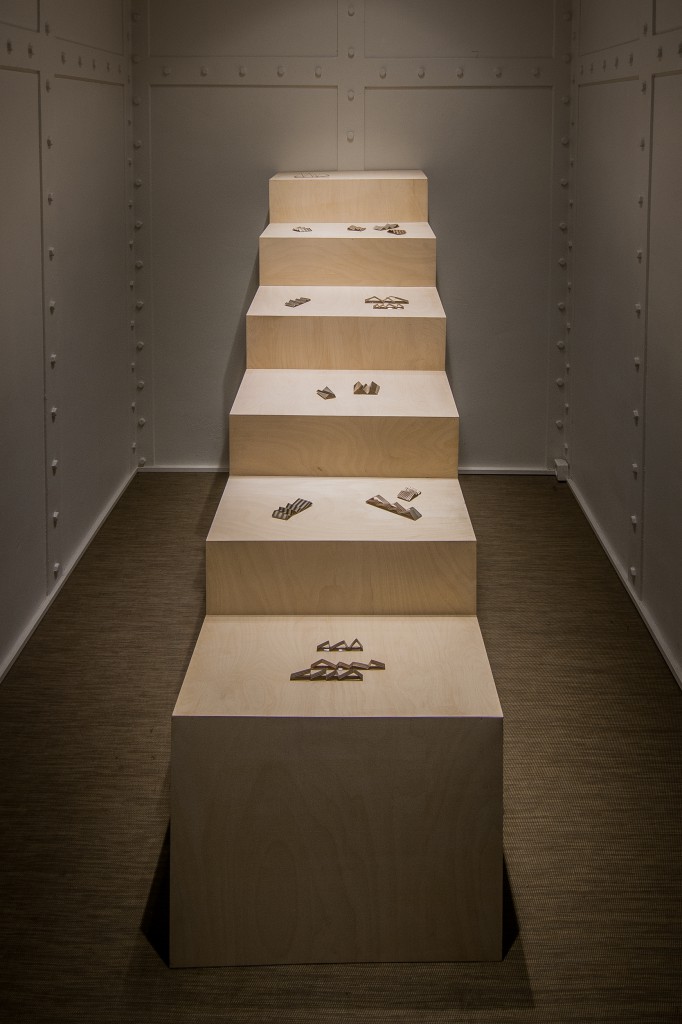
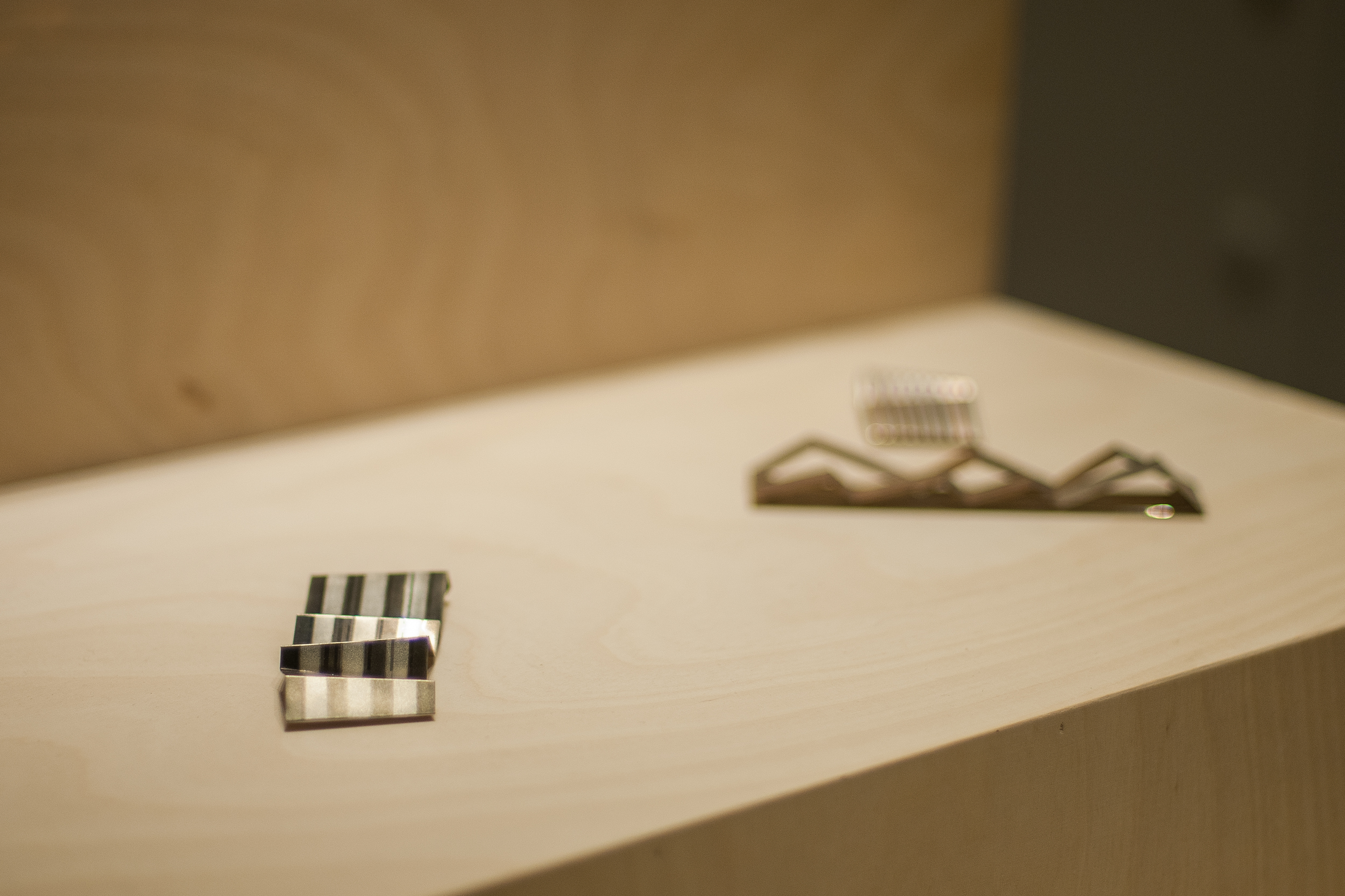
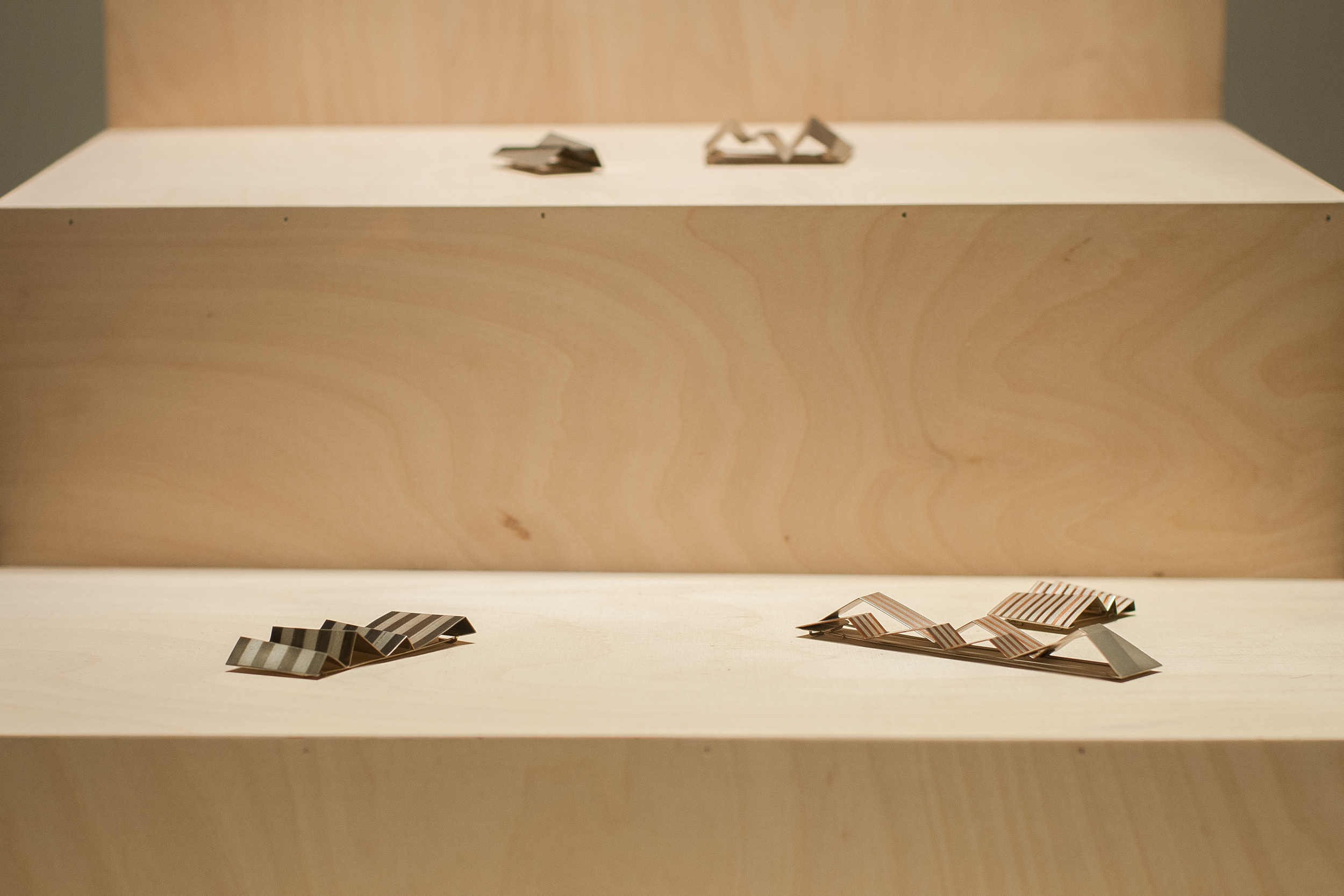
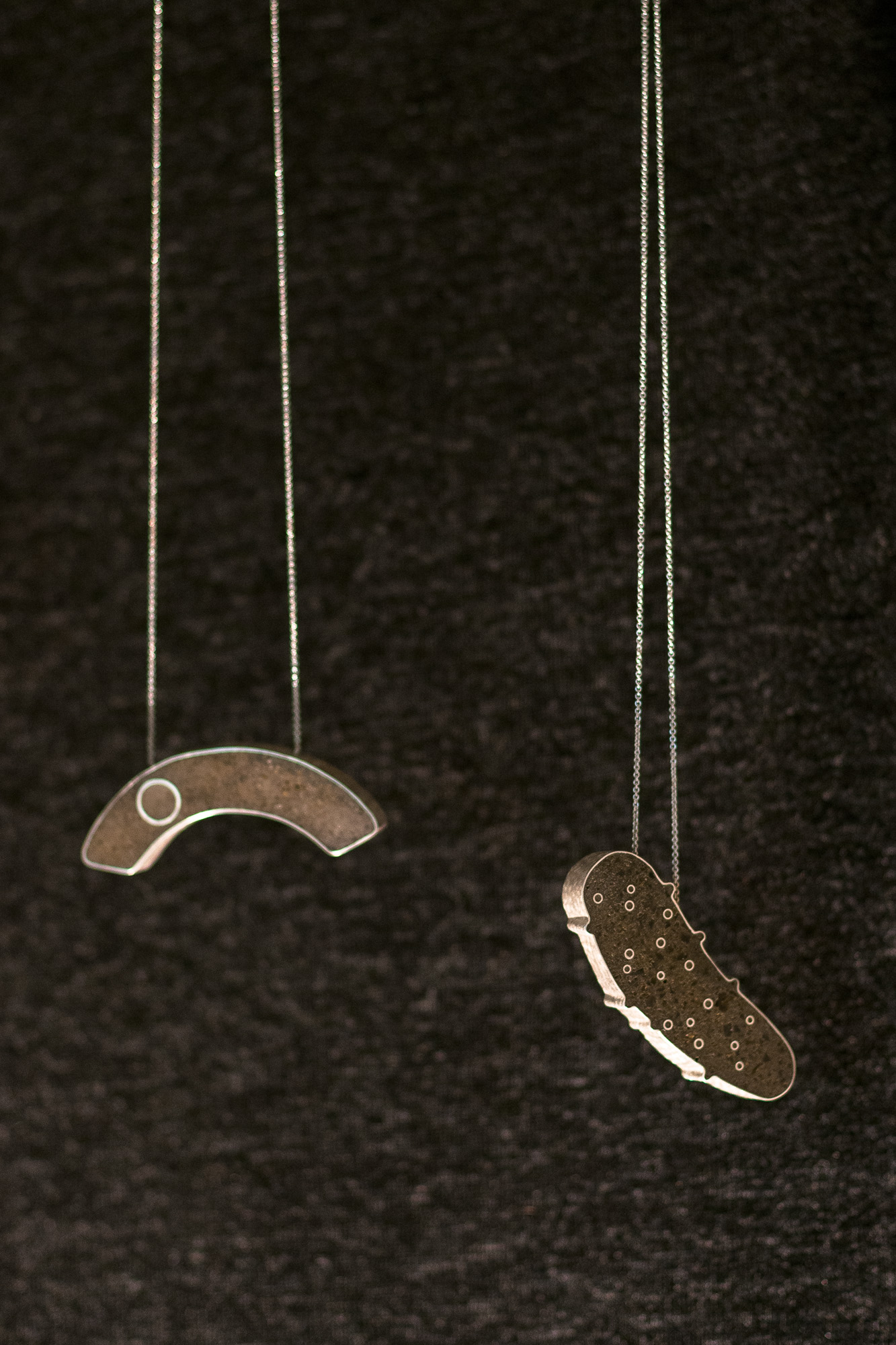
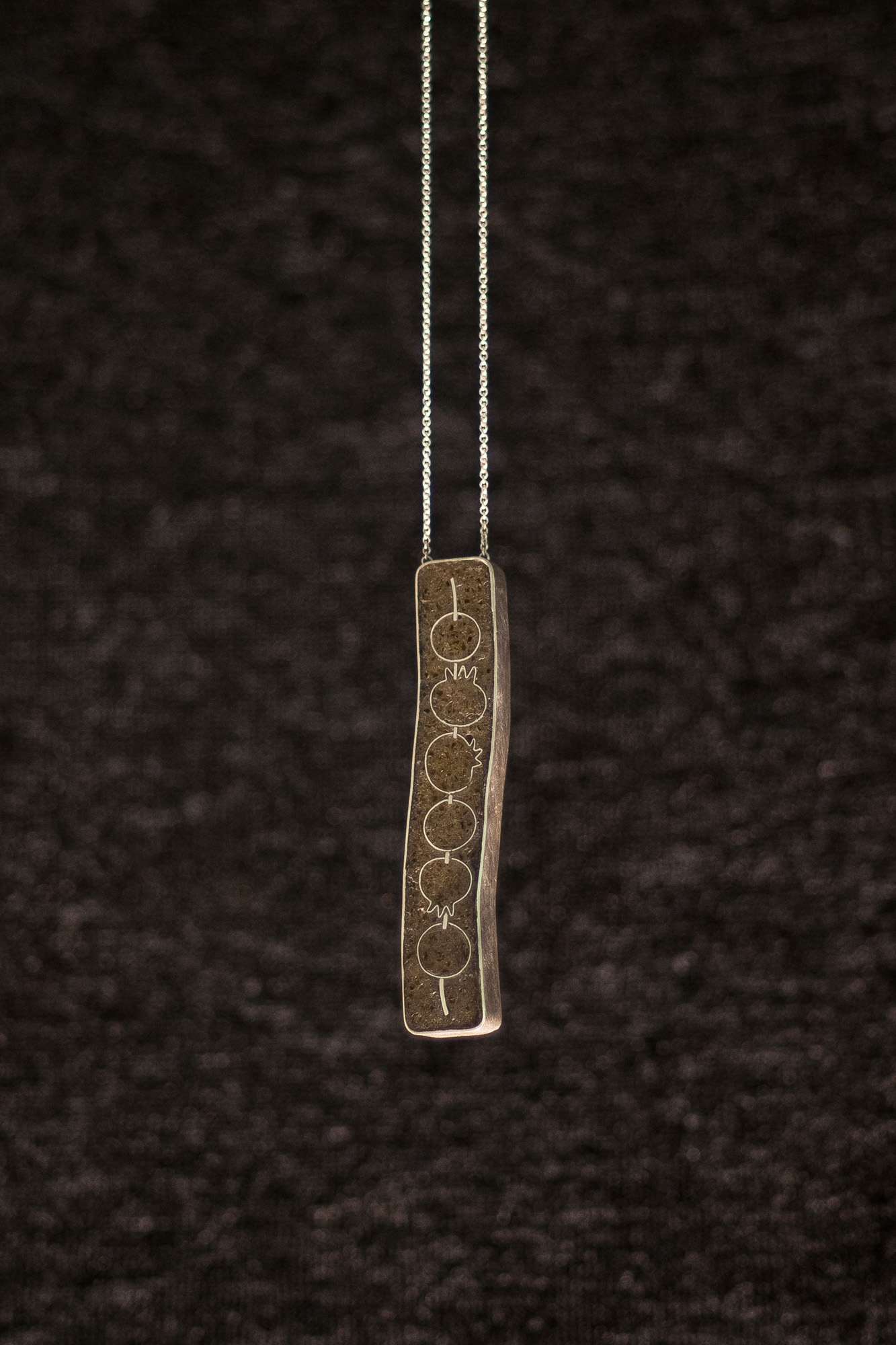
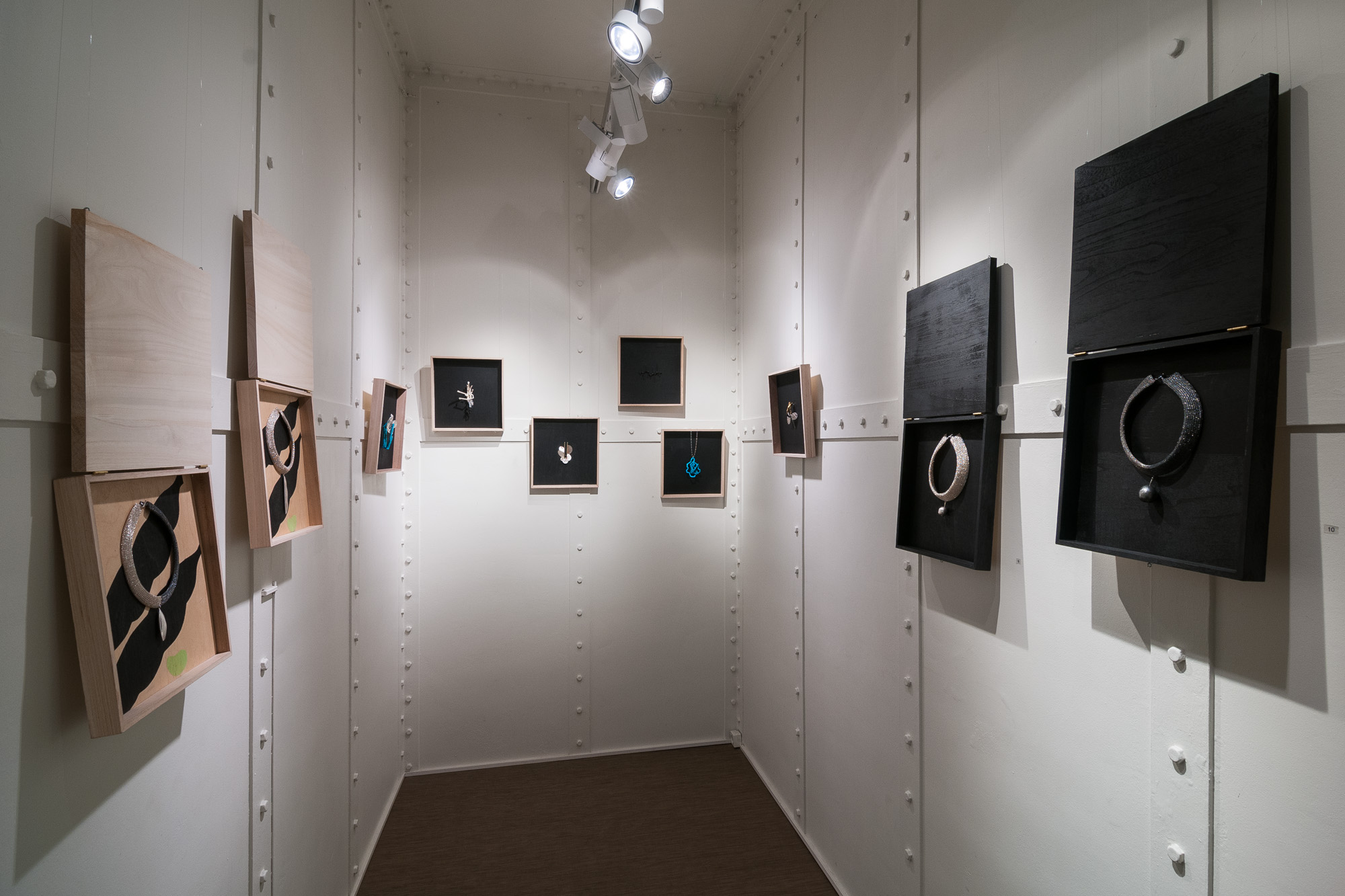
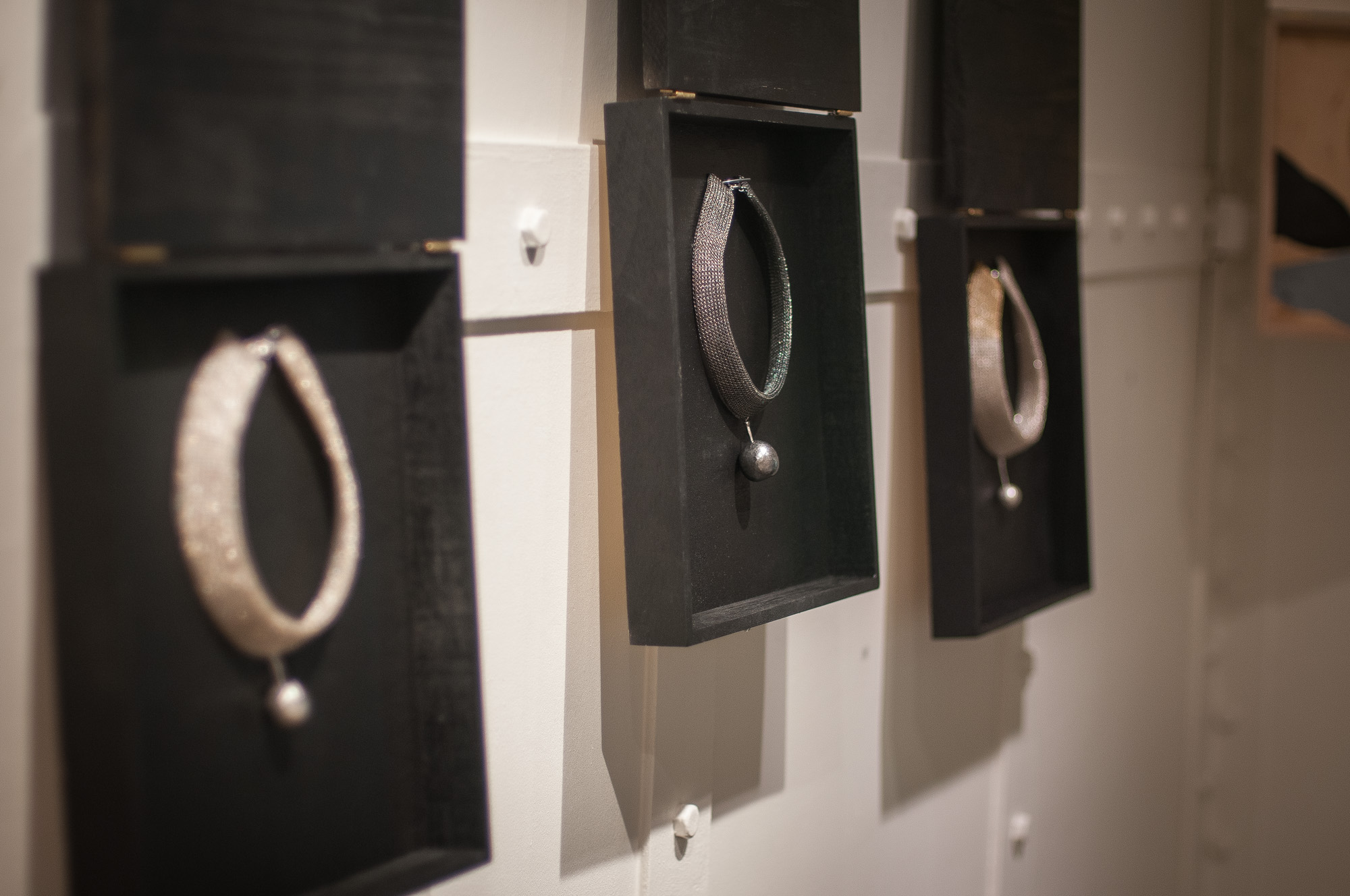
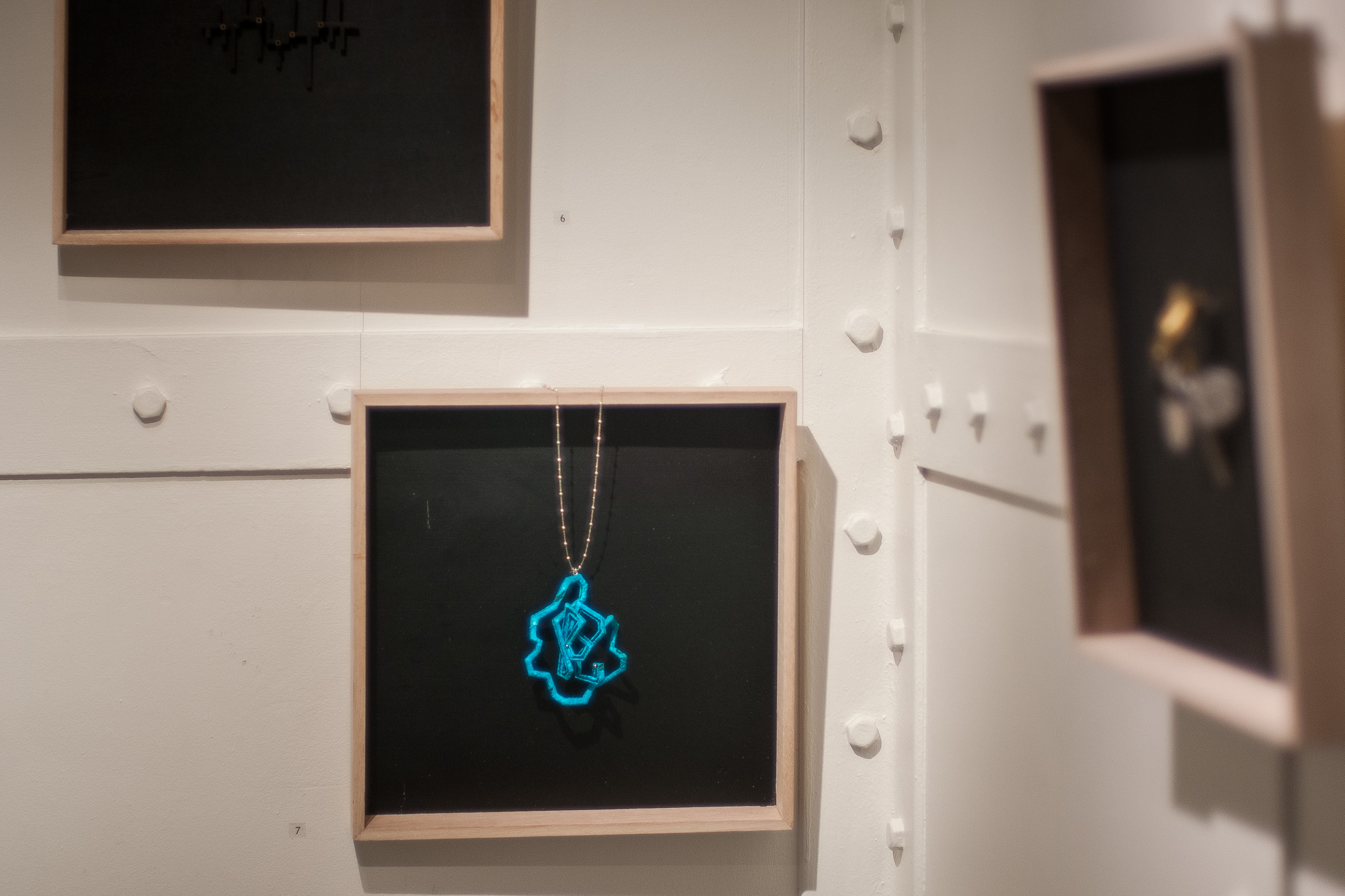
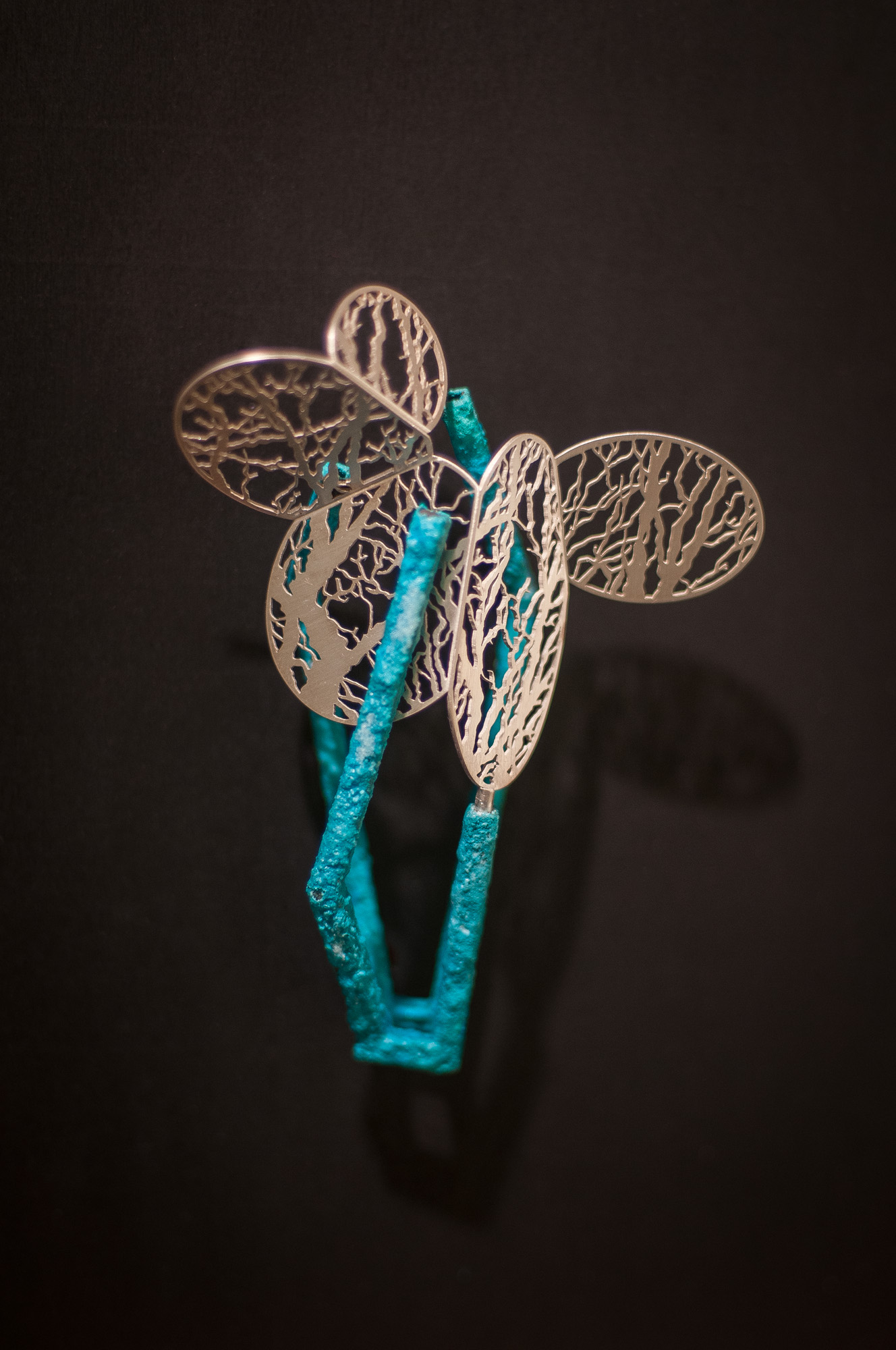
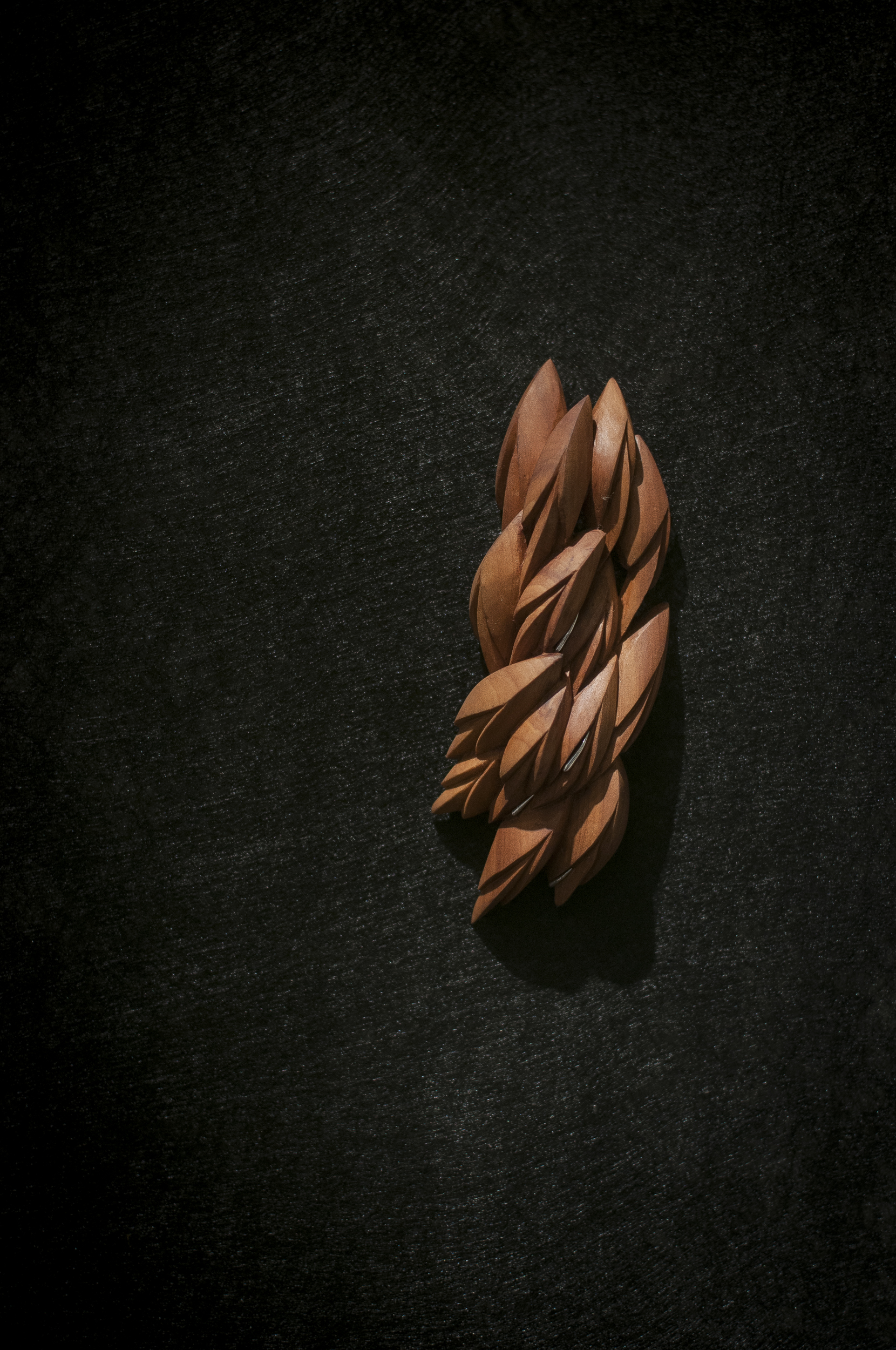
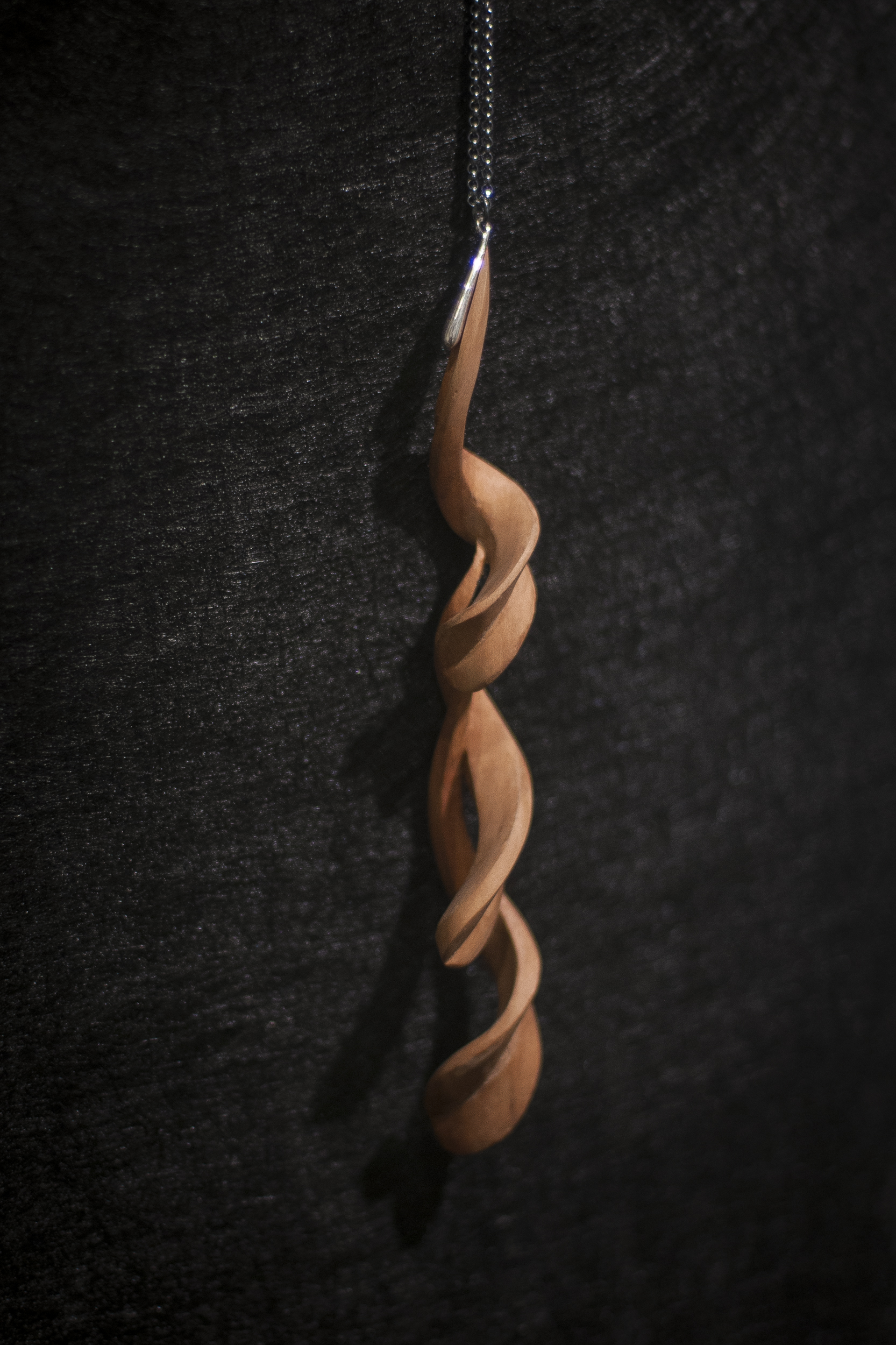
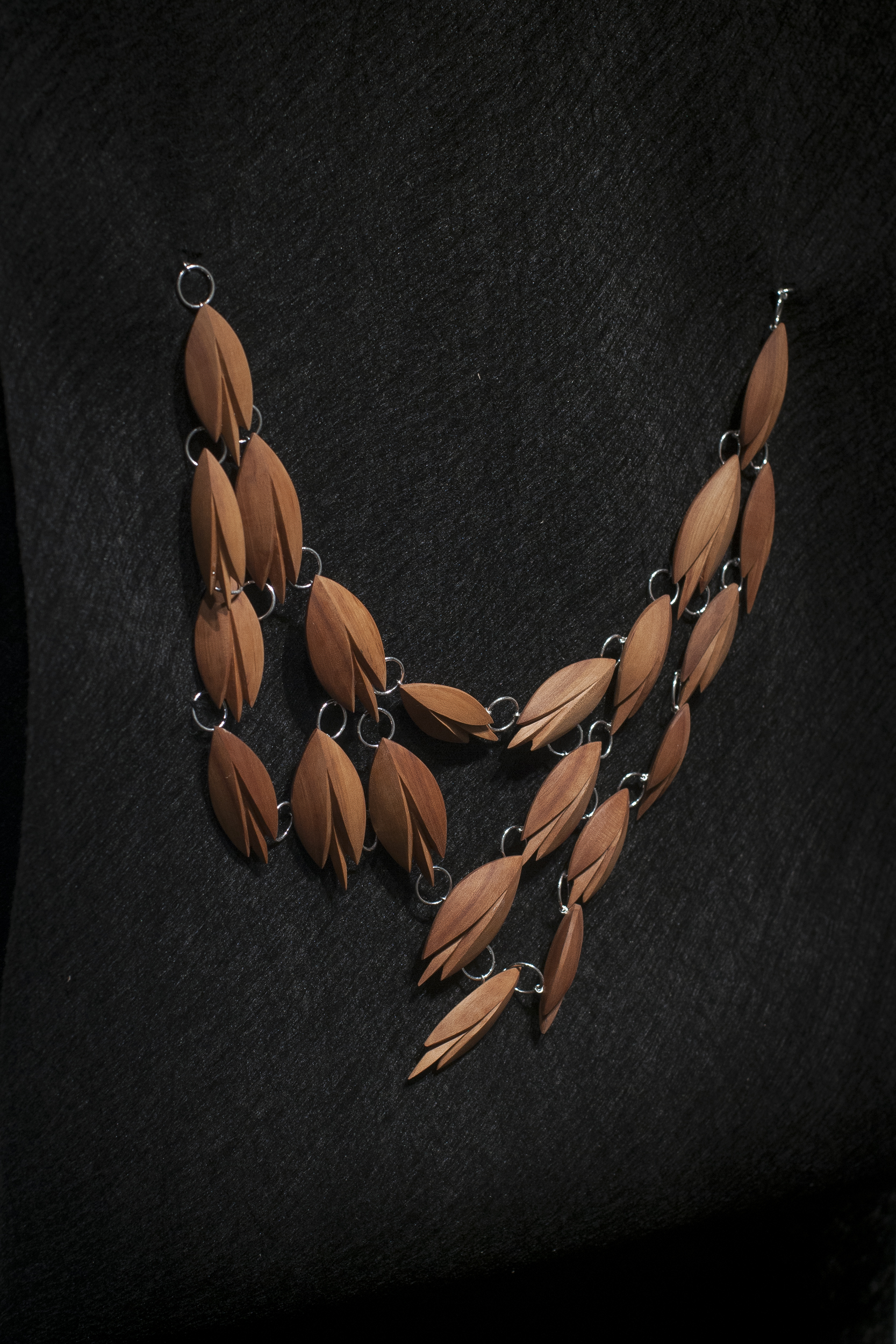
Jewellery artist Ülle Kõuts’s personal exhibition On the Stairs is in the Vault Room of A-Gallery.
Ülle Kõuts: “Being on the stairs implies movement from one point to the next. Often such movement occurs on a winding staircase, where at times it is necessary to stop to marshall one’s resources… to reassess… and then still and again to move on…”
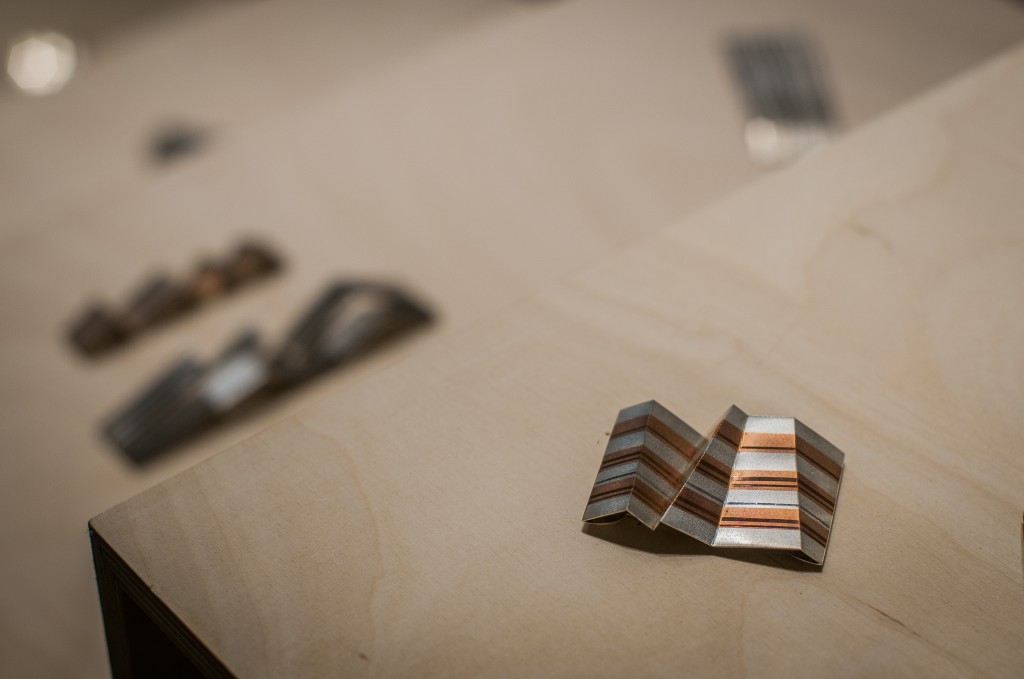
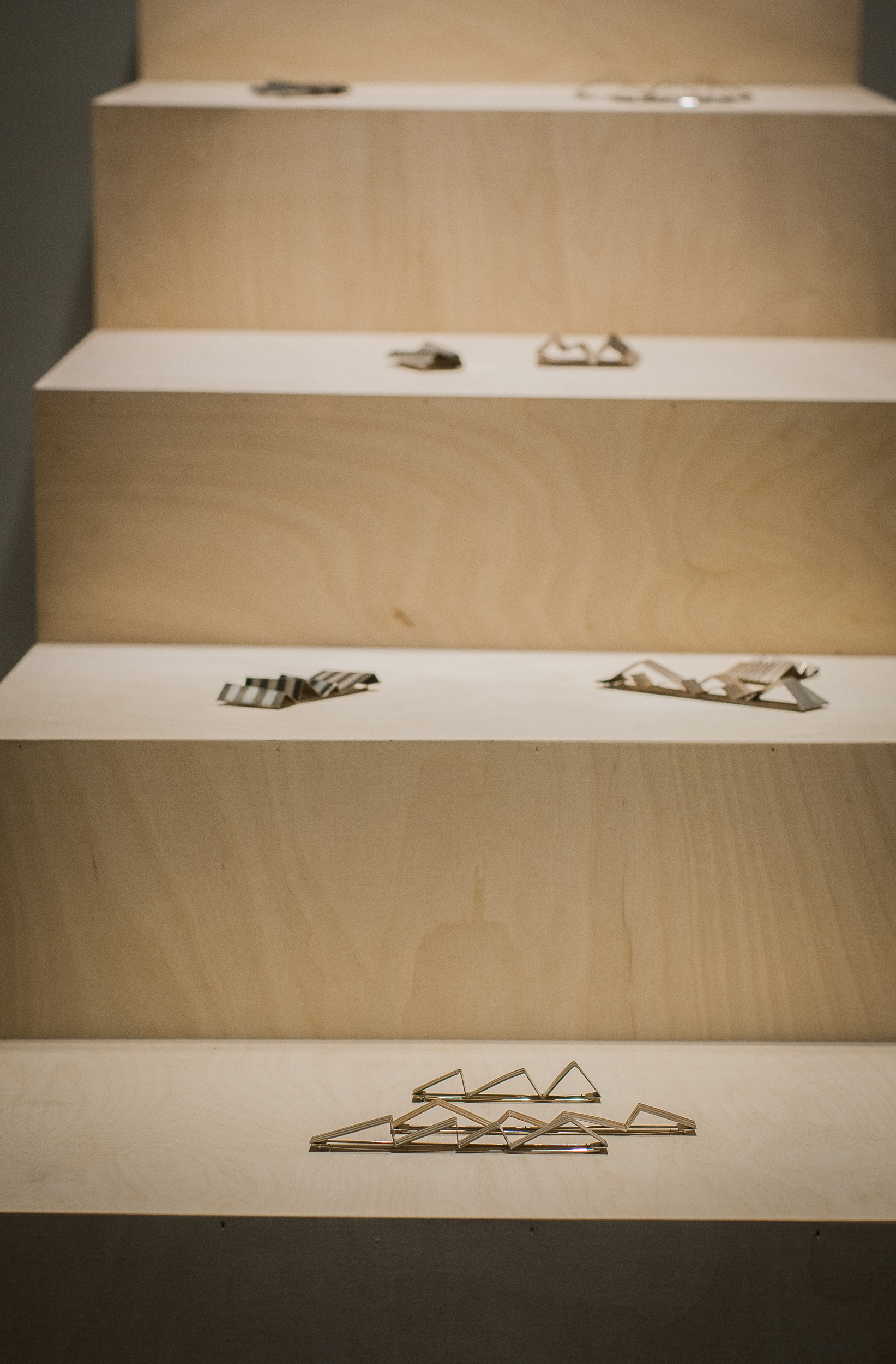
At her current exhibition the artist presents folded breastpins that have been completed in the “marriage of metals”- author’s technique where the artist creates characteristic stripes while soldering silver with copper or German silver. Kõuts’ minimalistic style is known already from her earlier works. Yet, the artist has reached a new artistic approach and arrived at a new level.
Ülle Kõuts (b. 1956, Pärnu) has graduated from the Estonian State Art Institute in 1980. Since then she has participated in numerous exhibitions in Estonia and abroad. Kõuts is a member of the Estonian Artists’ Association and Estonian Metal Artists’ Association. She is a co-founder of ON-Grupp and A-Gallery. Present exhibition On the Stairs is Ülle Kõuts’s third personal exhibition in the Vault Room of A-Gallery. Her previous exhibition Water was awarded with the Best Exhibition Prize held in the Vault Room in 2011. The annual prize serves as the recognition of jewellery artists by A-Gallery.
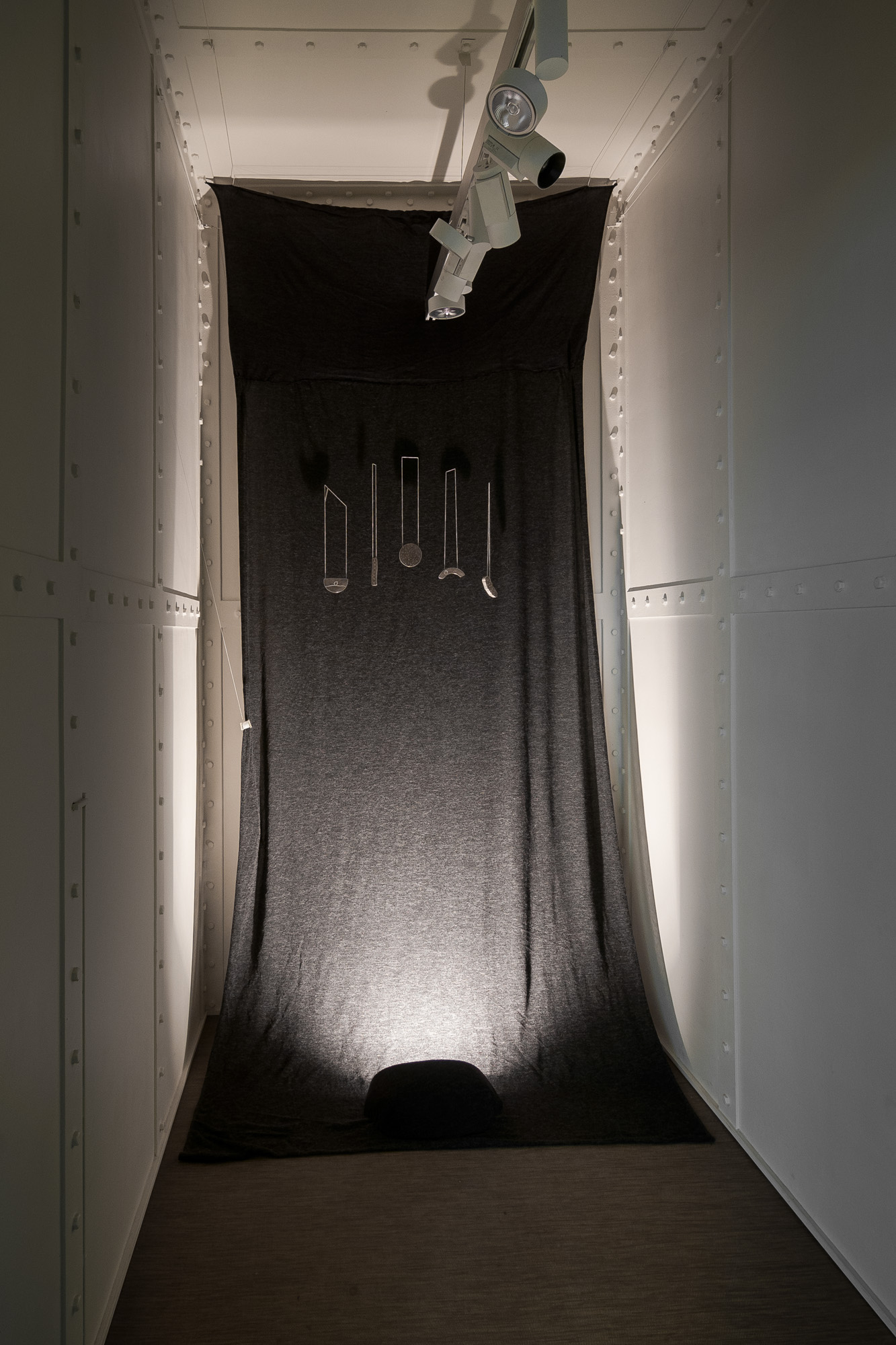
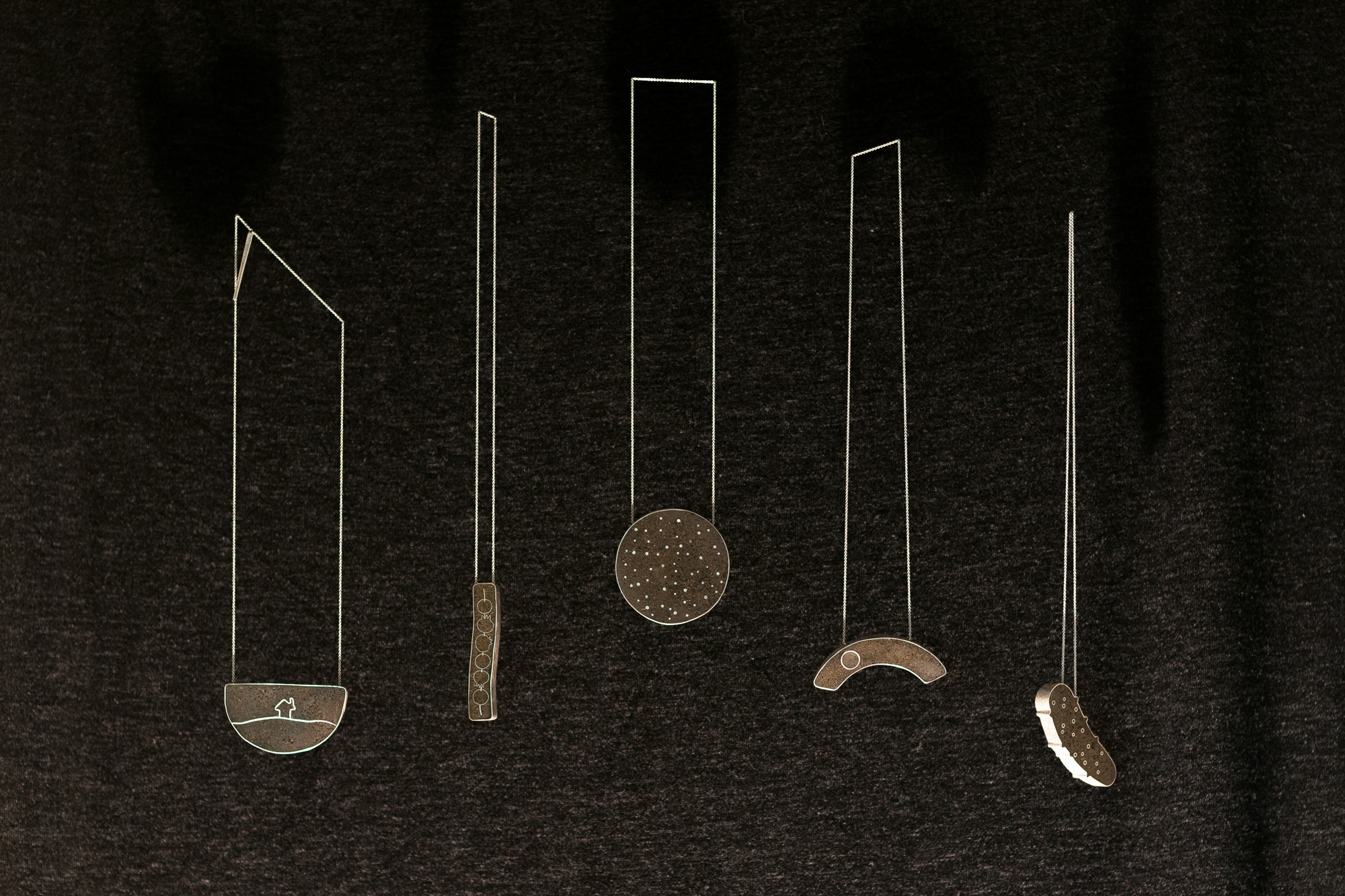
Quintet is a series of five jewellery pieces which can be both passively worn and actively played as instruments. Their forms illustrate cultural differences between Australia and Estonia as experienced by the maker. The body of the form is filled with a crushed Vana Tallinn bottle, the most accessible physical Estonian product in Australia. Together their sounds make up the song which is played at their exhibition in The Vault. The song for Tallinn.
Current exhibition will partly continue the themes the artists introduced at their previous exhibition GARTEN (=garden, a piece of ground for growing plants) held in Berlin in 2016. The art project unites two jewellery artists from different generations whose work also seem to differ at first glance. However, the works exhibited have all something in common.
“We grow and we change while being always thirsty for something. As human beings, do we differ from plants that much after all and in what way?”
Katrin Veegen (b. 1978)
“Apples of the Paradise, beans left in the field, mouth of gold.”
Ive-Marie Köögard’s personal exhibition of classical jewellery art “All that glitters is not gold” will be open in the Vault Room of A-Gallery from January 9, 2017. “I have always been inspired by beautiful, shining stones and I cannot resist collecting these. This leaves me with no other choice than to use the stones for making new pieces of jewellery. Thus, my work has also been my hobby for the last 49 years”
The reason behind this collection lies in the artist’s endless interest in 17th and 18th century extravagant gemstone jewellery. Combining artistic analytics and free association, the aesthetic of precious jewellery merges with everyday stone constructions.
The series A Jewel among Stones playfully examines the relationship between these two different kinds of stonework. The two types are often seen as opposites, one being remarkably precious and the other merely a matter of necessity.
Common and practical stones also possess the aspect of aesthetic. Sometimes stones used in
construction execute beautiful patterns on the building walls or ground; jewels among stones, one could say. Likewise, gemstones famously desired for their preciousness and looks are utilised purely for their functional properties.
Interestingly, when put side by side, some images of gemstone jewellery and cobblestone streets make a perfect match. Often gemstone settings and the positioning of cobblestones are strikingly similar.
A Jewel among Stones presents an on-going collection of objects, jewellery and photographs.
Hanna Ryynänen is a Finnish jewellery artist currently working and living in the city of Lappeenranta. In 2016 she graduated from Saimaa UAS as Bachelor of Arts, her main field being jewellery art. Besides one-off pieces of jewellery and small series, she has been making objects, installations and small sculptures.
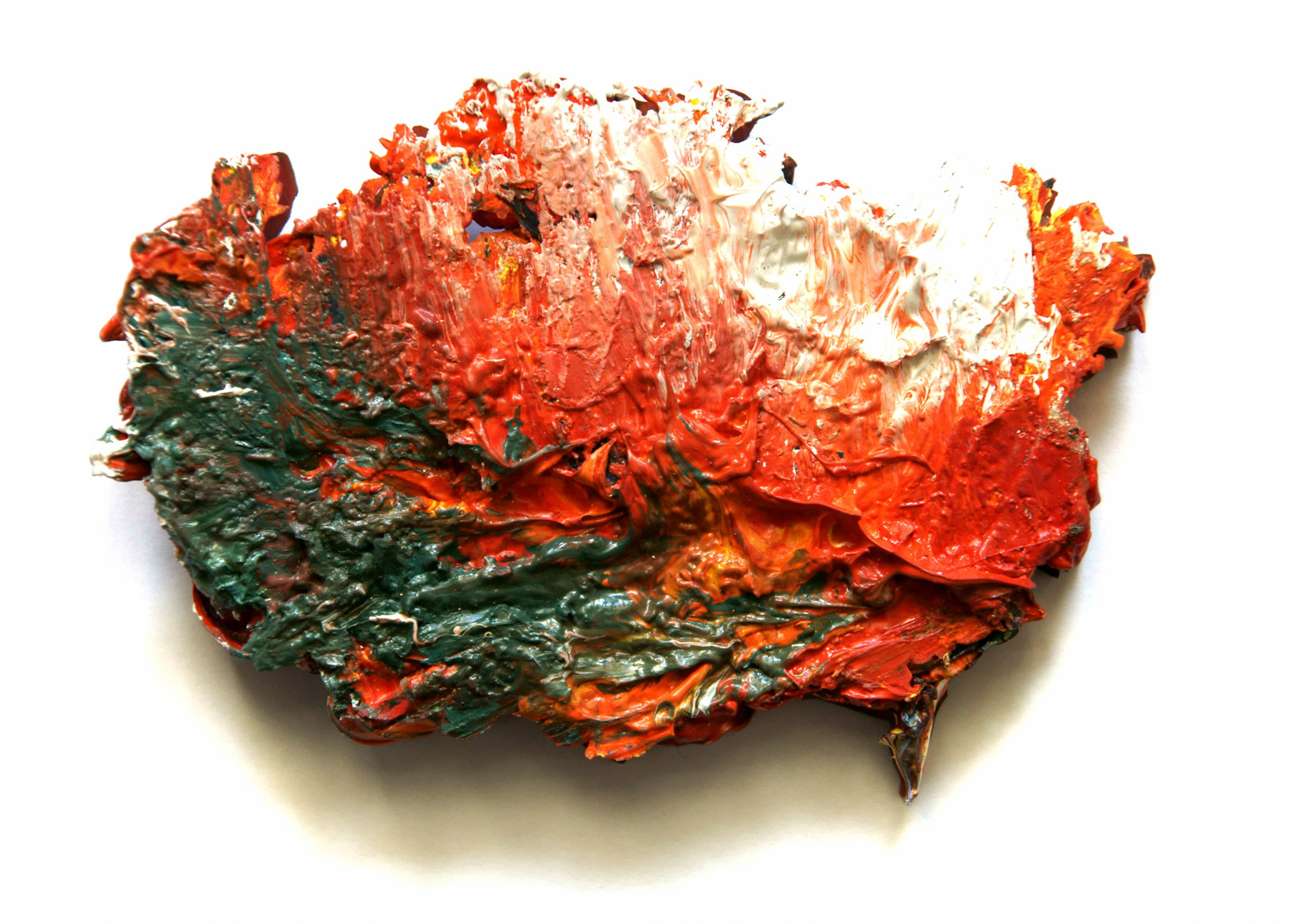
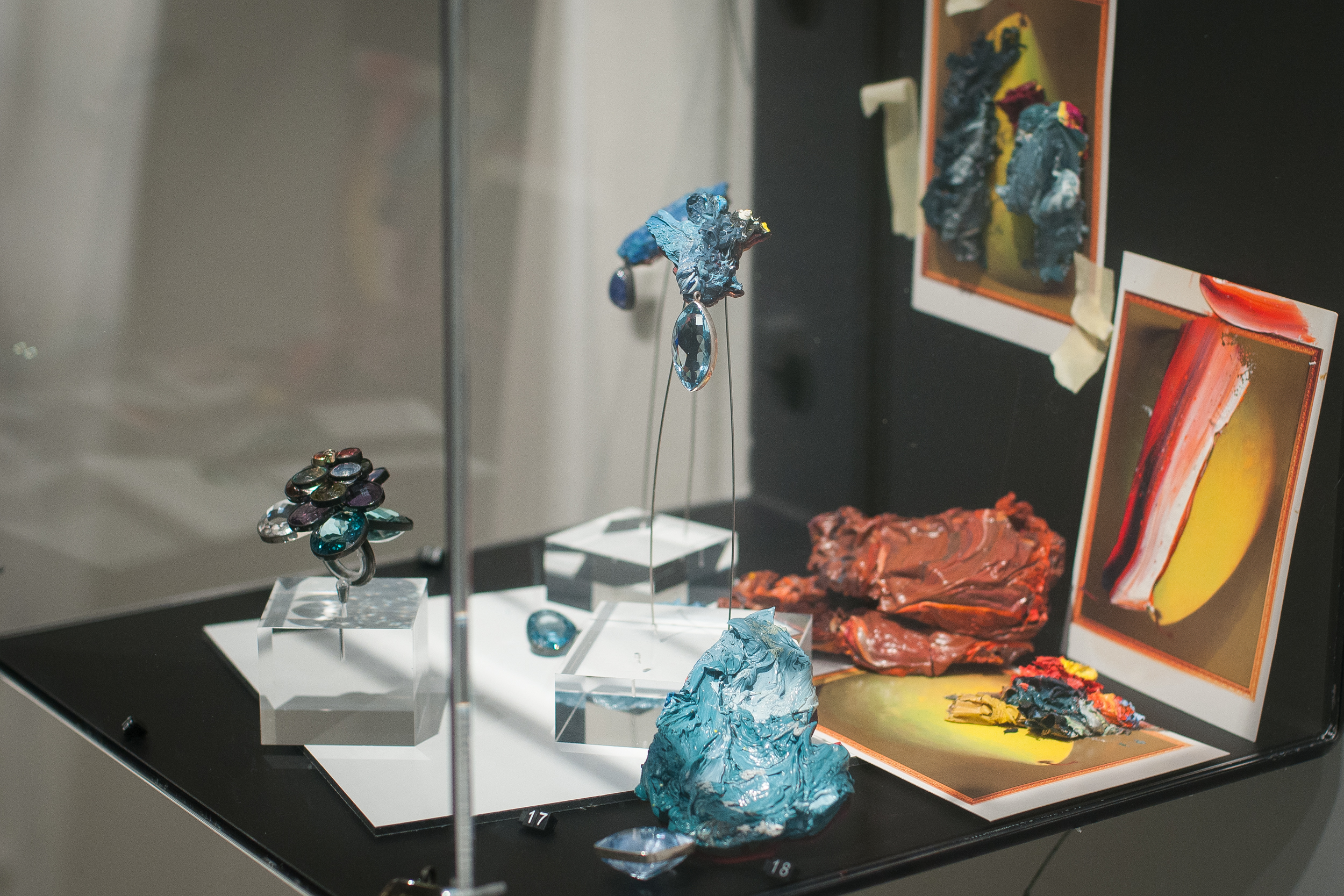
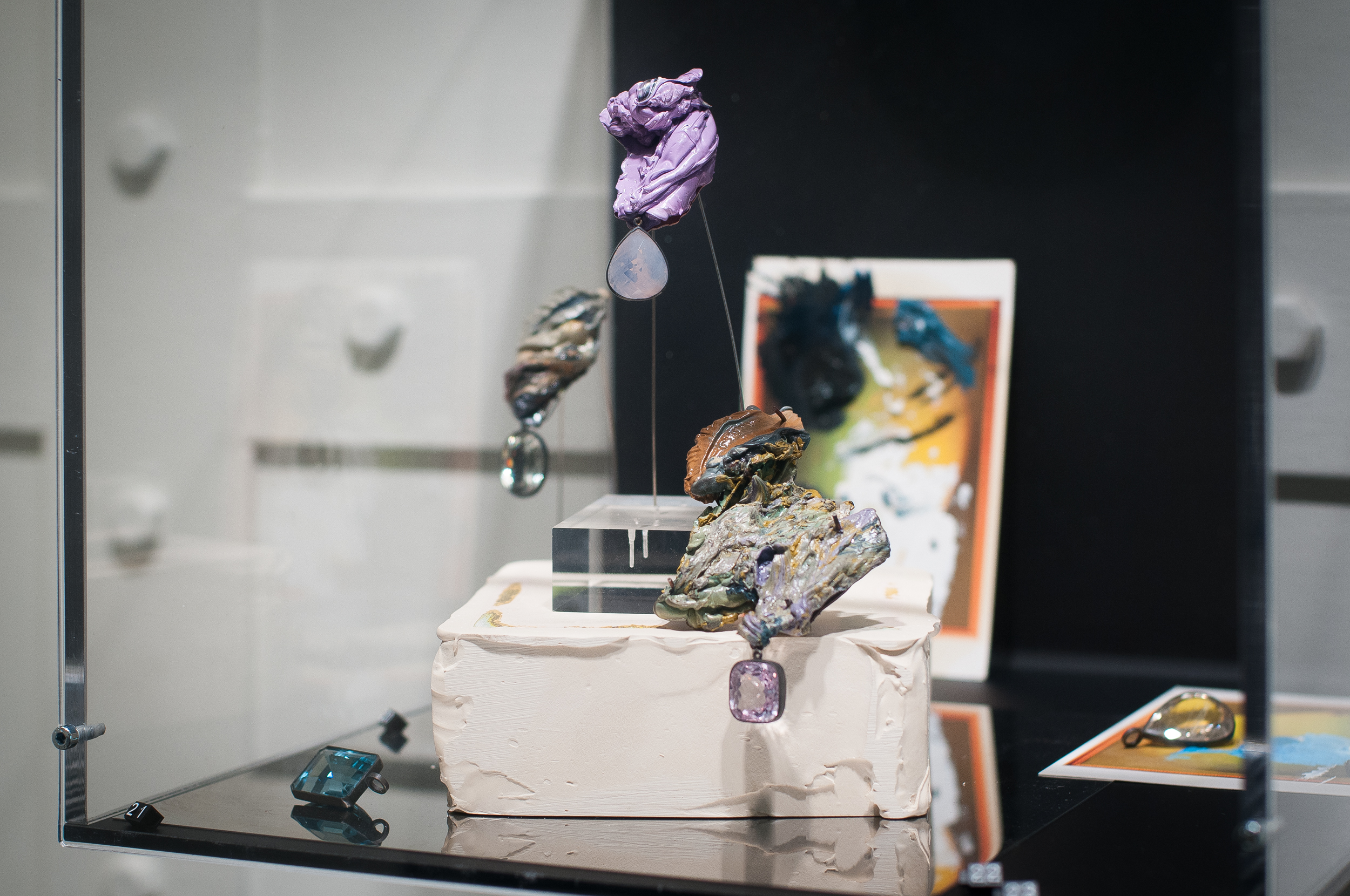
“Pieces of jewellery are not considered art, even if they really yearn for the status. Especially gold and gems. All kind of gimcrackery is not art, despite the fact that the display windows are full of them. Jewellery is non-art.” This is the message of Ivar Kaasik’s present exhibition where the artist presents works relating to paint and the faded brilliance of crystals.
What’s more – any kind of harmony, balance and compatibility has been avoided. There is lack of taste and beauty. The result is art. At least it really aims at being art. But is it enough in order to become a great work or art? Certainly not. However, when the objects were exhibited in a museum or an art gallery then even the smallest objects will become magnificent. Like in a fairy tale where words of wisdom are often expressed though vague hints or by birds and animals.
“What is your favourite colour and favourite stone? Where did you recently travel to? What kind of materials do you use? Why such incomprehensible names?” It gets really complicated when artists themselves have to talk about their work or to describe their creative process, to reveal facts about their family and home. One has to create a myth and remain in the shadow in order to offer the viewers the opportunity to decide themselves what to see. Whereas Kaasik’s earlier works have been covered with diamonds then his new pieces form a symbiosis of patches of paint, heaps of stones, surfaces covered with ash and dust. The artist has eliminated the measure of a man and the naturalness of material. The exposition reminds of plastic, nature has been replaced by hopelessness. When touching the pieces these will either fall into pieces or become totally broken. Trivial materials, deliberate errors, strong anonymity and shaky details contribute to the humorous atmosphere of the exhibition.
Ivar Kaasik was born on April 12, 1965 in Kuressaare. He studied in the department of architecture and later in the department of metal art of the Estonian Academy of Arts (former Estonian State Art Institute) in 1983-1992; in Burg Giebichenstein University of Art and Design, Halle in 1989-1990. Afterwards he worked various professions, for instance as a goldsmith in Germany in 1992-1999. Since 1999 Kaasik has been a freelance artist. He has participated in exhibitions since 1989. Kaasik is a member of Association of German Artists since 2001 and Estonian Artists’ Association since 2012. He is also a member of Estonian Metal Artists’ Union and Estonian Painters’ Union.
Ivar Kaasik has been awarded the Diamond International Award (1996) that is the most prestigeous awards for jewellery design. As a writer, Kaasik has expressed himself in his written work “Ettevaatust, kunst! Mida teha. Kuidas ja kui palju” (“Beware of art! What to do. How and how much”, published in 2011) where the author disregards pathos and traditional approaches in art and calls the genre of his book “minimum and maximum programme”.
Ivar Kaasik’s work is often incomprehensible; his pieces have been inspired by direct urge not to think and by the forced anonymous monologue, indirect hints and undubious possibilities of interpretation. Exploiting of the subject of being a man is one of main themes in Kaasik’s work whereas the artist is not stuck in the surface of social orders and expectations of mass culture but delves directly into the universe of bodily needs. Kaasik’s appropriational irony together with the phenomenon of craft and incomprehensible technique have developed temporal atmosphere and a somewhat artificial world soothed into singularity in his work. His jewellery can be juxtaposed to the stories without a happy end.
Is there anything that has not been seen yet? Perhaps this will become a new challenge for the art of jewellery: to display something that won’t deserve displaying. Art and crafts – are these the two arbitrarily referred poles between which contemporary jewellery art oscillates while never reaching the agreement and thus attracting the viewer’s interest. If disregarding the problems concerning the need for jewellery and the existence of a jewellery artist then which processes decide the status of jewellery in society? How are the processes related to the approaches and decisions made by people as social beings?
At this point, the emphasis is not on an impressive artisan skills of a goldsmith neither on a direct connection between the artist’s biography/psychology and his or her artwork. The thing only has to do with its own rationality. The following questions – who decides the development of a piece of jewellery and how is it made, who solves the issues related to the production process – must be treated individually with every artist. This is a game with specific dynamics where the patterns of process are accompanied by an incomprehensible opposition. Not only elegance but also bodily intrusion.
Kadi Kübarsepp was born in 1982 in Tallinn. She has obtained BA in the department of jewellery and blacksmithing at the Estonian Academy of Arts in 2008 and MA degree in 2011. Kübarsepp has participated in numerous group exhibitions both in Estonia and abroad and held 7 personal exhibitions in Estonia and in Helsinki, Finland (2015). The artist creates jewellery pieces using silver and steel wire where the main focus is on the line and its relation to space. The artist makes both wearable jewellery as well as sculptural forms whereas challenging the borders between object-jewellery pieces, printmaking and sculpture.
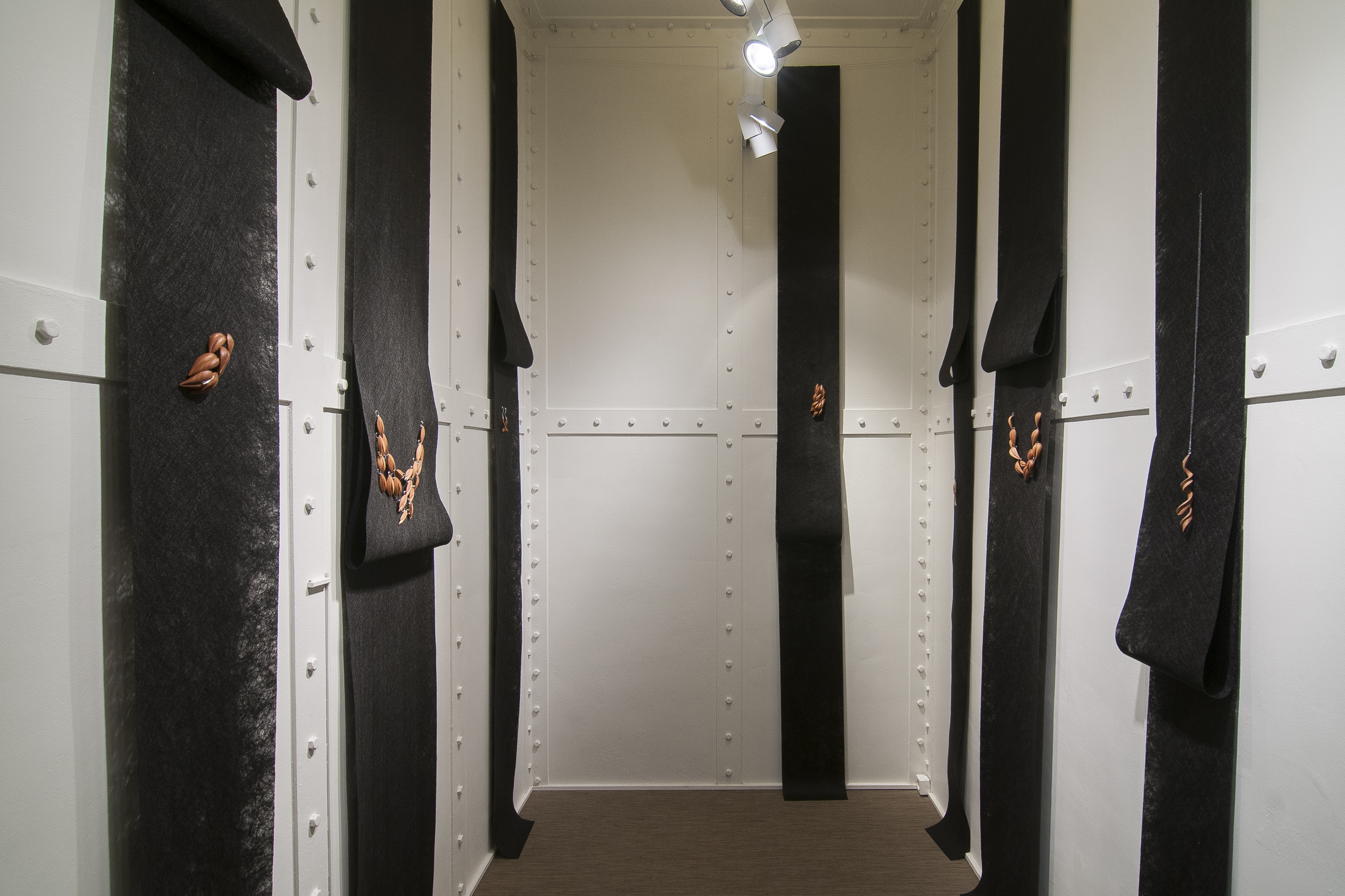
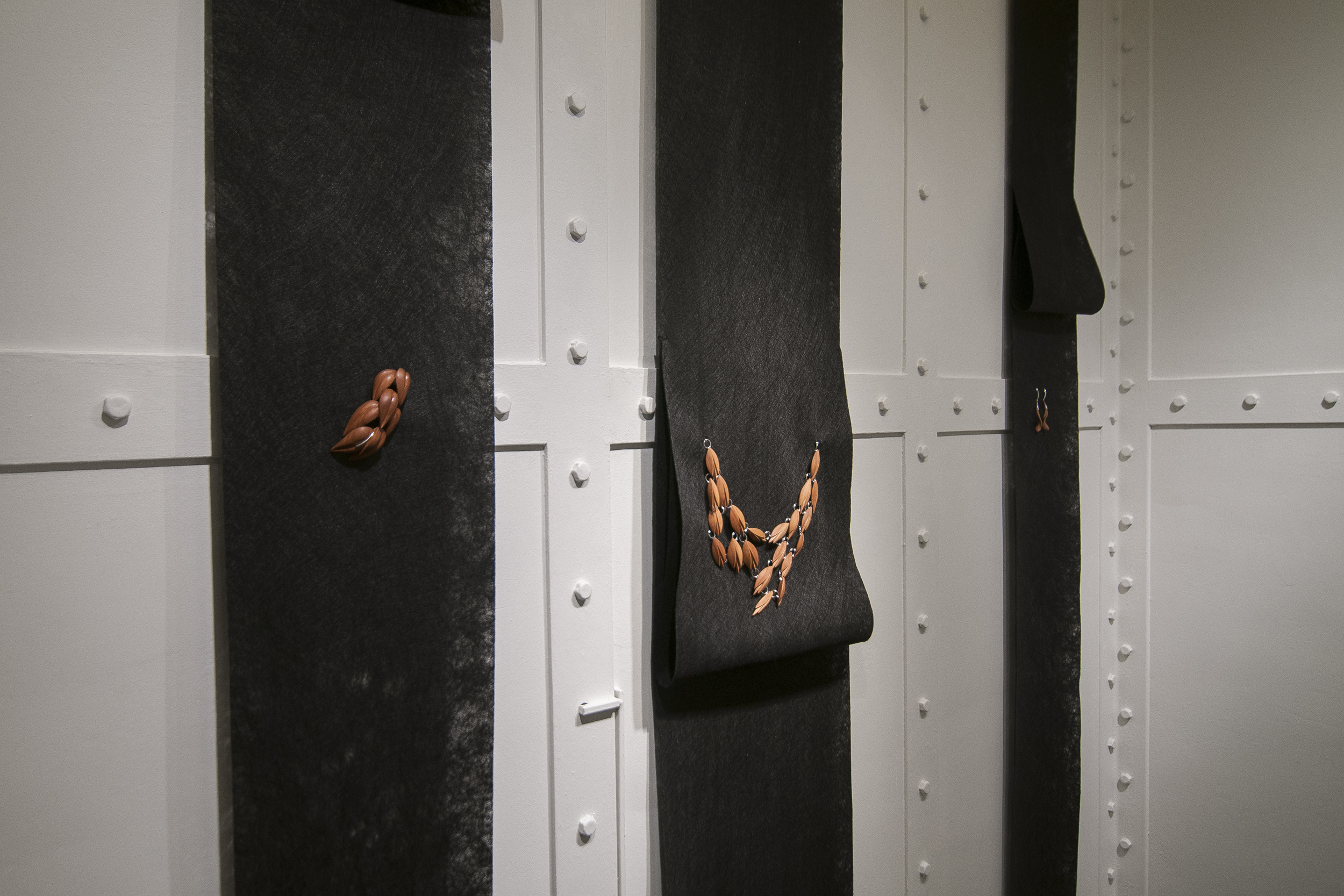
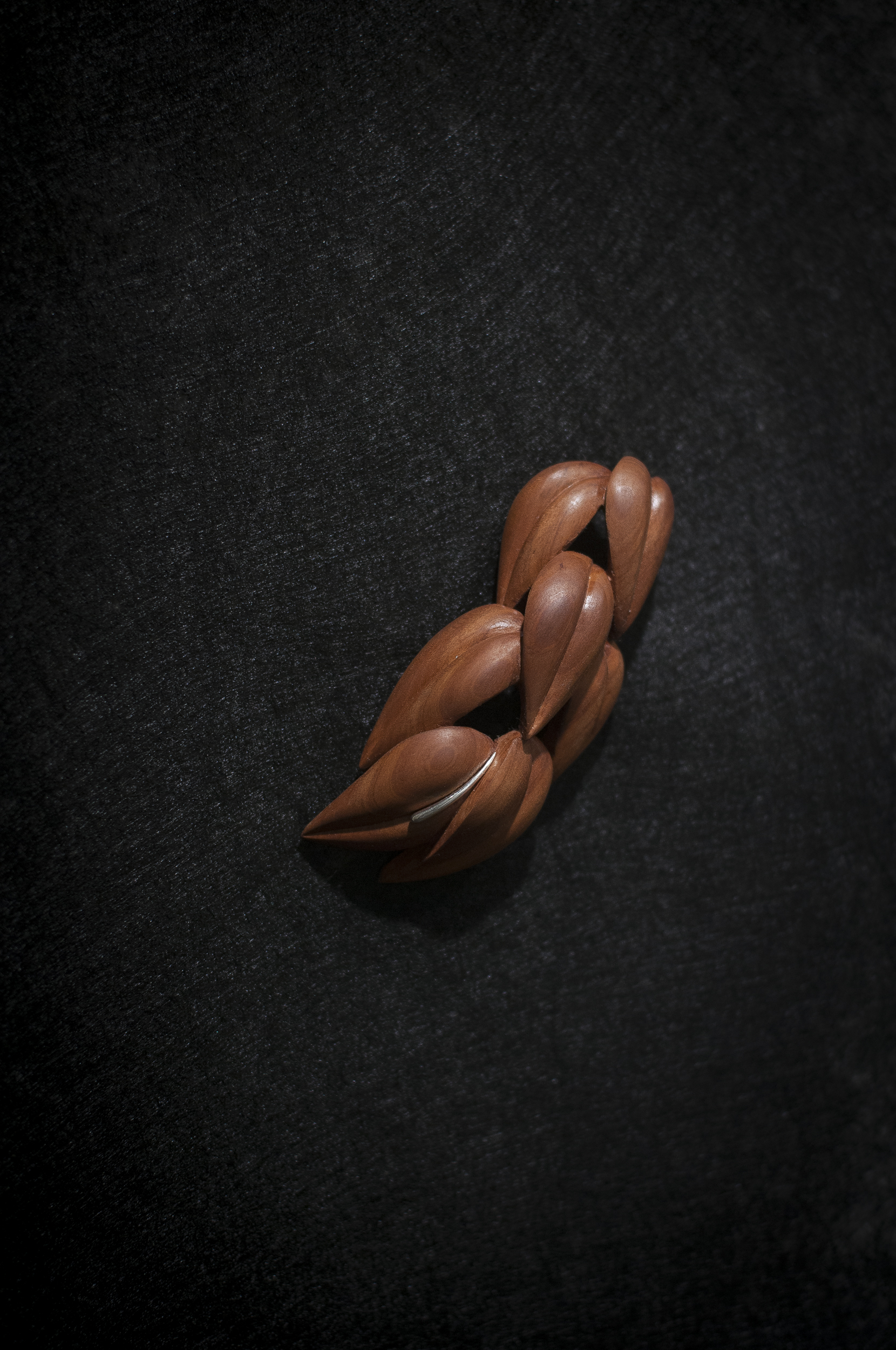
Is there another life and what is it about? Is it about changes in life, hoping for life after death, giving things a new life? Water and plants are inseparable from each other. Without water, a tree will become wood. At the current exhibition I have presented maple, apple and pear tree wood from my home garden – all the trees that have been cut down during my lifetime and the taste of their fruit are still in my mind. While modelling the wood I have attempted to reanimate them in the form of jewellery. Water that gave life to wood has been given “another life” in silver.
The central theme of the current exhibition is the Estonian homonym “jää” (“ice”). Ideas are wandering to the unknown just like moving along fragile ice through which transparent messages are being revealed.
– The thinner the ICE, the bigger the will to learn if it will endure the human weight – The present moment is the time that will be never SUFFICE.
“In my work, I record moments, findings, vanishing elements, symbols, words, touches … into the fragile ice / resin while trying to create unique memories, pieces of jewellery and miniature sculpture. I experiment with material while uniting precious metals, pieces of feathers, crystals, seeds, plants, stones, fossils, horsehair, transparent resin that imitates ice. A unique tension but also harmony and balance will arise between various materials. I try to include both happiness and sadness, moments of bitterness, hours borrowed from tomorrow in my work; a new output is being born in a lifeless transparent material. Vanishing traces, signs and words are revived in exhibition pieces and enter into a dialogue with the audience. Through my artwork I contemplate on the situation of both eternity and present moment. Moments must be cherished the same way as precious metals; thus, the piece of jewellery that one wears every day is the biggest treasure. You are the one creating value. Oscar Wilde has stated that nowadays people know the price of everything and the value of nothing. A ring or a bracelet made out of familiar birch bark may acquire special meaning. My purpose is to awake emotions, values and conversation in people. A human being is vain by nature – wearing jewellery gives us possibility to carry stories, thoughts, pieces of our past with us – all this give birth to new stories and impulses. Already the ancient peoples have dressed up and decorated themselves that has given them unbelievable power. I also invite the guests of the exhibition to take a look at the past, the future and the vanishing things surrounding us – maybe these will be revived in some way and this will become a form of communication with the closed ones. The vanishing ICE in the Arctic is a worrying fact that is changing geography, fauna and flora. Sometimes it seems that I attempt to record the last traces of things such as the ripe flower bud of a thistle or the white lightweight parts of feathers floating in the air. Let us catch the moments … With the present exhibition I am therefore drawing the viewers’ attention to global issues such as climate change: melting of ICE and raising temperatures – how this will influence nature, currents of air, winds? There are more questions than answers at the moment. Changes have been enormous; but if we will raise our consciousness then perhaps we might move to the right direction with our actions. And lastly: the one who changes with time will never become obsolete – even the fragile ice will carry them.