This year, the largest annual group exhibition of Estonian jewellery art turns its focus to values. At a time when value is so often reduced to numbers, the artists highlight other forms of worth – those shaped by collaboration, community, and the relationships that emerge in shared space. The exhibition brings together works by A-Galerii’s community alongside artists who have recently engaged with jewellery from new angles, creating a meeting point across generations and backgrounds.
The exhibition design by artist Karl Joonas Alamaa features soft figurative objects made from leftover garment textiles, combined with organic wooden and metal structures. It intertwines jewellery with sculptural forms and invites reflection on the role of jewellery amid the complexities of being human and living through sharply contrasting crises.
The title “One to Many” points to the tension between valuing uniqueness and universality, carrying an ironic undertone: whatever, just one among many. Each artwork becomes a small world of its own, a question and a possible answer. In a large group exhibition, seemingly similar parts multiply and individuality may blur, yet something distinctly original still emerges, offering new perspectives and unexpected shifts.
The exhibition is supported by the Cultural Endowment of Estonia.
Curator: Sille Luiga
Exhibition design: Karl Joonas Alamaa
Graphic design: Villem Sarapuu
64 artists: Mirjam Aun, Andrei Balašov, Merike Balod, Jens Andreas Clausen, Margus Elizarov, Rita-Livia Erikson, Kati Erme, Elize Hiiop, Tatiana Iakovleva, Hedi Jaansoo, Ivar Kaasik, Keesi Kapsta, Mari Käbin, Liisi Kõuhkna, Keiu Koppel, Ülle Kõuts, Kalle Kotselainen, Olga Tea Krek, Kadi Kübarsepp, Triin Kukk, Valdek Laur, Kristiina Laurits, Krista Lehari, Claudia Lepik, Viktorija Lillemets, Elis Liivo, Urmas Lüüs, Keiu Maasik, Tõnis Malkov, Henry Mardisalu, Ülle Mesikäpp, Juulia Aleksandra Mikson, Paul Aadam Mikson, Maarja Niinemägi, Erle Nemvalts, Ulrika Paemurru, Õnne Paulus, Margit Paulin, Mari Pärtelpoeg, Darja Popolitova, Ane Raunam, Anne Reinberg, Mari Relo-Šaulys, Liisa-Chrislin Saleh, Tamara Sergijenko, Kairi Sirendi, Birgit Skolimowski, Riin Somelar, Kärt Summatavet, Hansel Tai, Sven Tali, Harry Tensing, Margus Tänav, Bianca Triinu Toots, Kertu Tuberg, Maria Valdma-Härm, Ene Valter, Katrin Veegen, Kadi Veesaar, Kertu Vellerind, Tea Vellerind, Raili Vinn, Ülle Voosalu
SOMABirgit SkolimowskiBirgit SkolimowskiHarry TensingEne Valter
NEW WORLD Sofia Hallik / SOMA Jewellery
Estonian jewellery brand SOMA presents a new collection New World. The concept is based on a utopia about a symbiosis of Man and the Planet without the threat of environmental and man-made disasters. In the course of self-improvement cycles, each new generation of artificial intelligence emerged faster and faster, generating a kind of “intellectual explosion”. Ultimately, a planet endowed with super-intelligence, superior to that of all mankind, appeared.
The amorphous form of the New World, flowing from one to another shape, is reflected in the jewellery from the new collection. The author allows the software to determine the shape of the jewellery by setting certain parameters in the software. The process of creating goes on in a new way, where the machine takes upon itself the role of a creator.
Gender fluid jewellery from New World collection is 3D printed from recycled sterling silver.
Sofia Hallik (1991), the founder and CEO of SOMA Jewellery brand, is a jeweller, designer and PhD researcher at the Estonian Academy of Arts. In her doctoral thesis, Sofia examines the impact of digital technology on jewellery making.
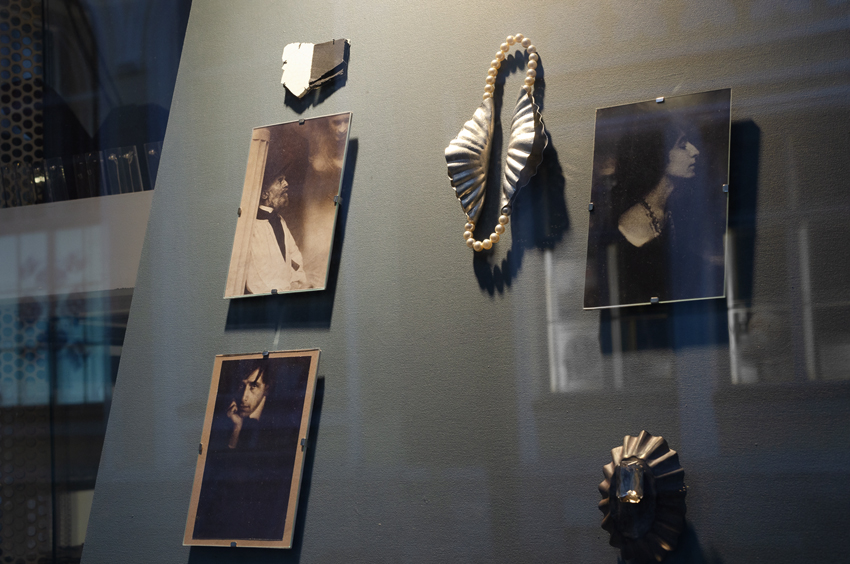
WHAT IF… Birgit Skolimowski
In 1891, goldsmith Joseph Kopf opened here, at Hobusepea Street 2 one of the most notable and fine jewellery shops in Tallinn. For example, a decorative plate for Swedish crown prince Gustav Adolf as well as the chain of office of the first president of Estonia, Konstantin Päts, were made here. By today, almost 130 years have passed since the jewellery shop opened. If only we could go back in time and work in the environment and atmosphere of that time…
What if… ….we as jewellery artists of today could go back and create jewellery for people of the past?
What was the significance of jewellery at the time? What was considered jewellery – was it only diamonds and gold? Would jewellery of today have spoken to people of the past? How much has the meaning of jewellery changed since then? Does jewellery protect or decorate us? Can ugly be beautiful and does form determine content? Can aesthetics and beauty be trivial? Do you always need a reason to adorn yourself?
Form must be discussed, the content is evaluated by the viewer. The maker of jewellery always has a story but when a piece of jewellery is commissioned by someone, their story is revealed through the maker’s interpretation.
I imagined myself meeting and talking to the people commissioning jewellery in those years, with joys and sorrows long gone by now. I listened to their stories and made those ideas into jewellery.
Birgit Skolimowski (1977) graduated the jewellery department at the Estonian Academy of Art 2006 (BA) and a year later she enrolled in the MA programme. Soon her daughters were born and for a couple of years she focused on being a mother. This, however, never stopped her from creating jewellery. By now she has worked in her studio, here at Hobusepea Street 2 for almost 13 years. Her daily work is divided between creating small series and commissioned works. Skolimowski has worked with numerous Estonian fashion designers and created jewellery for their shows as well as for their clients for special events. She describes herself: “I love to create feminine and romantic jewellery with simple and minimal form. I’m inspired by life – people, architecture and, of course, nature. I will probably stay here, at the studio at Hobusepea Street and create jewellery for the rest of my life – I have still not grown tired of it.“
THE IMPOSSIBILITY OF TURNING BACK Harry Tensing
The artist is intrigued by the question whether there are ways for turning back to something that is gone. During his artistic research, the artist engraved arbitrary motifs onto silver plates; the play with random thoughts created a fictitious meaning. After having sawed the plates into small pieces, the artist recombined them and constructed new stories in the form of jewellery. Imprints taken of the plates beforehand serve as the only proof of their existence.
By adding semi-precious stones to the silver details a collection of jewellery was born, confirming the impossibility of turning back.
Harry Tensing (1972) graduated from the department of sculpture at Tartu Art School (1992) and the department of jewellery and blacksmithing at the Estonian Academy of Arts (1998. He is currently working as a goldsmith in a historical enterprise Roman Tavast and as a freelance jewellery artist.
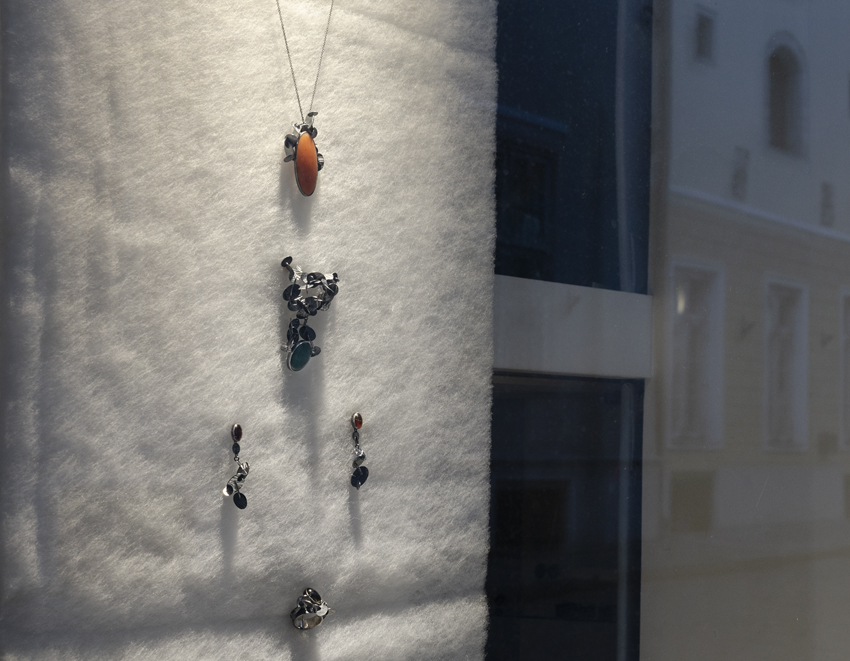
EUREKA Ene Valter
In preparation for each artwork, intense creative thinking is required. I love taking a particular material, precious stone, metaphor or symbol as the starting point when creating jewellery and then thinking around it, trying out forms, techniques and visuals. Often this testing period can be quite long and completion of the works needs to be put on hold. The antique corals in this exhibition waited for their time before becoming a piece of jewellery for several years. But finally, the long-awaited clarity arrived, I came to a solution and was able to exclaim with great satisfaction: EUREKA!
Ene Valter (1952) graduated from the Department of Jewellery and Blacksmithing at the State Art Institute of Estonian SSR in 1977. After graduating she worked as a freelance artist and in 1986 she became a member of the Estonian Artists’ Association. Ene Valter is one of the founders of A-gallery and is currently working as a CEO at ARS-Vasetööd OÜ. A large part of Valter’s work is designing and making coats of arms for boroughs, medallions, awards and badges of honour, which she has always seen as a subset of jewellery art. In jewellery Valter values clarity, simple form and timelessness. Alongside silver, she uses high heat enamels when creating jewellery and badges, as that allows to satisfy her “colour hunger” in the rather monochrome choice of materials.
Above all, she enjoys designing and making chains of office for mayors, rectors of establishments of higher education and presidents of organisations. Valter significantly contributed in creating the gold chain of office for the President of Estonia for the republic’s 90th anniversary. She also authored the 5 kroon metal coin with the image of Jaan Koort’s deer. Ene Valter has presented solo exhibitions in Finland, Hungary and Estonia and has been nominated for the Jewellery of the Year Award in 2018.
The event is supported by the Estonian Cultural Endowment.