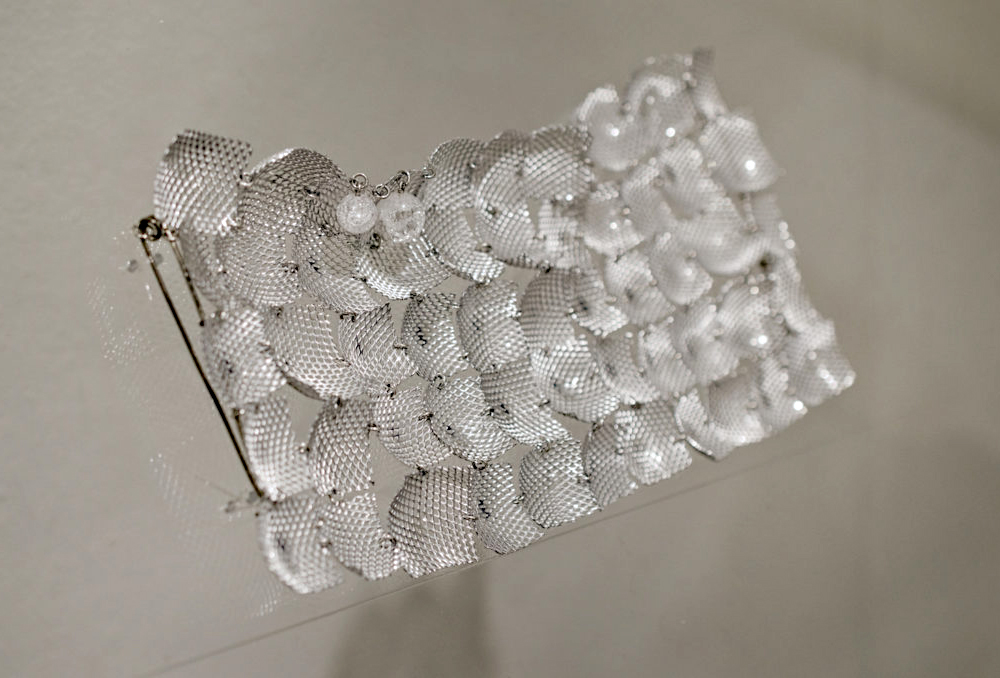
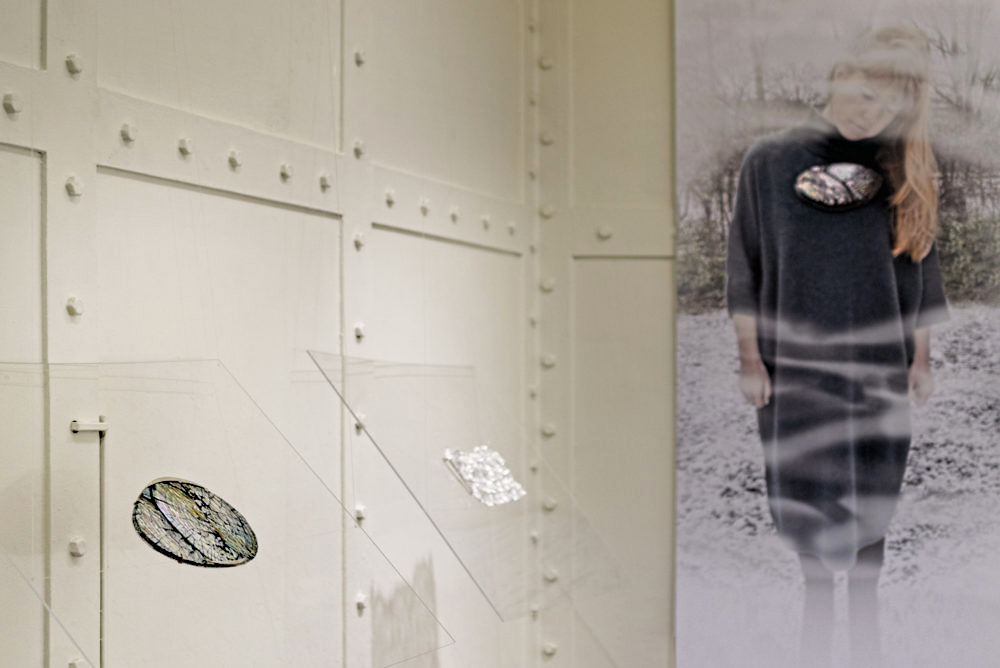
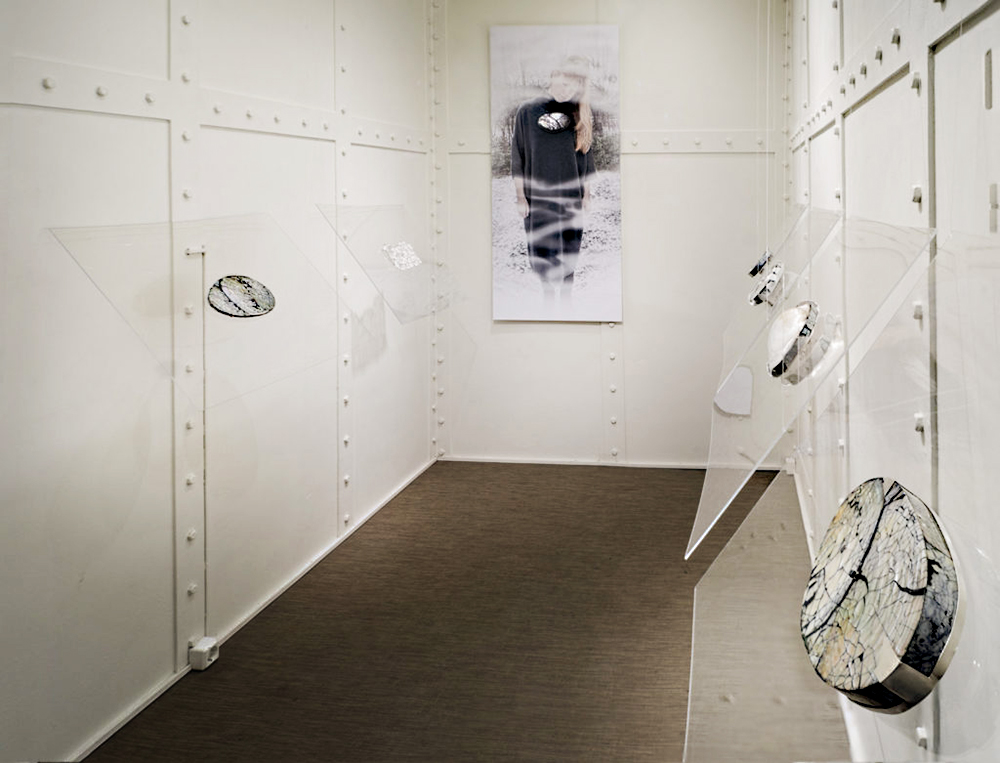
TIME, a celebration of the 85. birthday of the filigree-master Aino Kapsta, is an overview of her works created over the recent years.
“My exhibition is a cross-section of the ideas I have arrived at when working in my beloved filigree technique which has fascinated me for decades now. I have often found myself starting from the centre, then moving towards the edges – a process I have discovered to closely resemble making of mandalas. Into each element and detail I have laid good thoughts. Making this exhibition was a kind of therapy for me: I was deeply at peace and experienced the lightness of overwhelming joy.
The show includes three autonomous sets of works: brooches, pendants and neck pieces.
The brooches carry the initial vision of the show, the luminescence of clouds, while the pendants and neck pieces pushed the concept forward. Mostly, I chose to use semi-precious stones. Quartz with its brightness fits my vision perfectly, the powerful essence of garnets and the warmth of topaz is supported by gold spheres. I wish for the inner peace and harmony to radiate to the viewers through my work.”
Aino Kapsta was born in Saaremaa in 1935. She graduated from Kuressaare Secondary School and continued her studies at the State Art Institute. Although Kapsta’s first choice was sculpture, in 1961 she graduated from the Metal Department and in 1966 became a member of the Estonian Artists’ Association. It is probably thanks to her sculpture studies that she created several panels, fountains, decorative metal grids, clocks, and sculptures in Narva, Tartu, Moscow, Jurmala and Saaremaa, many of them in collaboration with Mai Mägi.
Even though Kapsta has always enjoyed experimenting with materials and techniques, due to circumstances brass, red copper, bronze, melchior, and new silver remained her favourite materials for a long time. A wide selection of these items belongs to the collection of Estonian Applied Art and Design Museum.
Freedom to use precious metals allowed for experimenting with new techniques. For example, melting numerous small details into various compositions, and of course, filigree technique, which is creatively extremely satisfying due to its complexity and abundant detail, while being simultaneously fragile and delicate, yet powerful and resilient.
The King of Serpents is a wise companion and powerful energy within the freely flowing body. In Estonian fairy tales and folklore this great and glorious mystical serpent will come to help people when they need to be saved and give them advice. Sometimes he also helps people to get medicine or heals them when they have been attacked by poisonous snakes. In many cultures around the World the King of Serpents are holy mythological powers who do not harm and protect people. Within the body of man, this is a circulation of energies as the serpent around the central axis or the Tree of Life, Sephiroth, the serpent of wisdom, Kundalini, timelessness and immortality.
Kärt Summatavet (PhD) is Professor of Liberal Arts at the University of Tartu. She graduated in Tallinn as a metal artist (1982-1987) and exhibits since 1986. She made her doctoral dissertation in Finland in the Department of Design at the Aalto University in Helsinki (1998-2005). She is an artist, researcher, project manager, expert in creative industries, designer-entrepreneur and innovator.
COMIC “COMPOST” Kertu Tuberg
“after a meal the juicier part is consumed only remains bones and crumbs a matter of taste”
Kertu Tuberg is a freelance jewellery artist based in Tartu. She has higher education from the Estonian Academy of Arts. Tuberg has participated in exhibitions since 2001.
WORK NIGHT Kaire Rannik
These are pieces that are born at night, blind, sad and lonely. It’s good to bring them to light to see if they like it or to find someone they might like them. Whether there is a story hidden in them or not is up to the viewers to decide.
Kaire Rannik is a jewellery artist who graduated from the Estonian Academy of Arts, whose works were already recognized in the early years with the Young Artist Award at the Tallinn Applied Arts Triennial in 1997. As the member of the artist group F.F.F.F. in 2002 with the annual award of the Estonian Cultural Endowment. The jewellery artist, who is active in the Estonian design landscape daily, loves the hidden beauty in simplicity and draws inspiration from domestic nature and basic geometric elements. Every Kaire Ranniku jewellery also has a timeless connection with the grandfather who worked in the Old Town of Tallinn as a goldsmith, which is reflected in the wonderfully clean finish of his charming jewellery and high-level goldsmithing.
R_R HI-TECH Risto Tali and Rait Siska
The central motive of the bracelet is a unique locking system that appears after a laser-cut titanium sheet has been formed to 3-Dimensional shape. In this function, it creates an effective and elegant visual pattern that technically holds the bracelet together, though it seems like it should not do so. This exhibition is introducing the process as well as the unique piece of jewelry created by the authors, who tend to think in metal. Inspirations are partly coming from the medieval the knights, and treads, Old town of Tallinn where both authors live and work, and keep the blacksmith non-profit association called “Porta Longi Montis MTÜ” at “seppade torn”(blacksmiths tower).
Rait Siska and Risto Tali are fruitful tandem of artists, who have participated in numerous art contest, winning and producing many pieces of art from 2003-2020. As well their art has been exhibited in so many occasions, if to list it all, we would need lots of paper and time. Most known are probably the works “Butterfly Gates” at Tartu University Narva College, situated in Narva. The biggest ongoing project is working with Bocuse d`Or Estonia. This cooperation has lasted so far for 10 years. It includes the design and production of an individual set of ceremonial dishes for each competition candidate of Estonia. This co-work was also been exhibited this year on the 24.th February Estonian Independence day reception at Viljandi, held by The Office of the President of the Republic of Estonia. The latest work that has been in public attention was the design of 15€ silver coin, dedicated to Jüri Jaakson, issued by Estonian Bank.
The exhibition, initially titled PARTY, was intended to take place in April. In the winds of the historical events, it developed into a new iteration – PARTY’S OVER.
The objects presented at the exhibition can be seen as a bittersweet quest to finding sanctity in contemporary life that is often void of meaning. Through the prism of absurdity, the exhibition ponders on the use and uselessness of the celebratory state of mind, as well as the use in said uselessness.
Below some notes of a party that’s over:
“The party is over. Why, with whom, when, where, to whom, how – these details do not matter. What matters is whether the party was fun or not.”
– I have noticed that in Estonia many things, like childhood, school time, and even life itself, are trivially compared to a party. Party seems like a simple pleasure – responsibility and rules do not play a remarkable role, as one can only participate and doesn’t have to worry about the organizing.
– The phrase ‘party’s over’ is also thrown into the air very lightly. Party as an adjective is uniformly applied to the whole period before the disaster. It is noted with a bittersweetness that time seems to reveal a pattern, a regularity, that the good times don’t last and punishment for them is certain. Situations where the phrase “party’s over” is used are usually not appropriate for it, because a party is valued by how special and extraordinary it is. The disaster that makes people say ‘party’s over’ is not the opposite of a party. For me, the opposite of a party is a smooth passage of time without special moments. A quick change, a surprise, means that the party has just begun.
– A party is a revolt against the steady passing of time. Party wins moments but loses to eternity. Eternity will always be boring. I do not believe that man should go through his life doomed dull forever. Instead, time should be wasted, so the indifference of time could be resisted. Moments must be heightened.
Parties can be life-changing or at least they celebrate life-changing events. What should I remember, commemorate, celebrate, forget? Birth, birthday, marriage, funeral, in memoriam day, Easter, Midsummer’s day, Halloween, Christmas, ordinary get-togethers, complete ragers, weeks of binge drinking – just to name a few. Has partying become outdated? Half from the list of celebrations have become very rare occasions in my life. Would more parties save humanity? Save from what? From an eternity of boredom probably.
Sille Luiga (1994) is a master student of jewelry art at the Estonian Academy of Arts and has also studied in Italy and Belgium. Recent exhibitions she has participated in are NID SHOWROOM in London, XENTE NOVA in Santiago de Compostela and JEWELRY AND ANATOMY in Porto. The exhibition PARTY’S OVER is her first solo exhibition. With her objects she wishes to explore ideas about decorating and adorning in a broad absurd embracing way. Soon Sille will defend her master’s thesis on the same topics.
From Friday 29 May, the Vault of A-gallery hosts the solo exhibition of jewelry artist Sille Luiga. The exhibition, initially titled PARTY, was intended to take place in April. In the winds of the historical events, it developed into a new iteration – PARTY’S OVER.
The objects presented at the exhibition can be seen as a bittersweet quest to finding sanctity in contemporary life that is often void of meaning. Through the prism of absurdity, the exhibition ponders on the use and uselessness of the celebratory state of mind, as well as the use in said uselessness.
••••
Below some notes of a party that’s over:
“The party is over. Why, with whom, when, where, to whom, how – these details do not matter. What matters is whether the party was fun or not.”
• I have noticed that in Estonia many things, like childhood, school time, and even life itself, are trivially compared to a party. Party seems like a simple pleasure – responsibility and rules do not play a remarkable role, as one can only participate and doesn’t have to worry about the organizing.
• The phrase ‘party’s over’ is also thrown into the air very lightly. Party as an adjective is uniformly applied to the whole period before the disaster. It is noted with a bittersweetness that time seems to reveal a pattern, a regularity, that the good times don’t last and punishment for them is certain. Situations where the phrase “party’s over” is used are usually not appropriate for it, because a party is valued by how special and extraordinary it is. The disaster that makes people say ‘party’s over’ is not the opposite of a party. For me, the opposite of a party is a smooth passage of time without special moments. A quick change, a surprise, means that the party has just begun.
• A party is a revolt against the steady passing of time. Party wins moments but loses to eternity. Eternity will always be boring. I do not believe that man should go through his life doomed dull forever. Instead, time should be wasted, so the indifference of time could be resisted. Moments must be heightened.
• Parties can be life-changing or at least they celebrate life-changing events. What should I remember, commemorate, celebrate, forget? Birth, birthday, marriage, funeral, in memoriam day, Easter, Midsummer’s day, Halloween, Christmas, ordinary get-togethers, complete ragers, weeks of binge drinking – just to name a few. Has partying become outdated? Half from the list of celebrations have become very rare occasions in my life. Would more parties save humanity? Save from what? From an eternity of boredom probably.
••••
Sille Luiga (1994) is a master student of jewelry art at the Estonian Academy of Arts and has also studied in Italy and Belgium. Recent exhibitions she has participated in are NID SHOWROOM in London, XENTE NOVA in Santiago de Compostela and JEWELRY AND ANATOMY in Porto. The exhibition PARTY’S OVER is her first solo exhibition. With her objects she wishes to explore ideas about decorating and adorning in a broad absurd embracing way. Soon Sille will defend her master’s thesis on the same topics.
••••
Sille Luiga PARTY IS OVER 29.05. – 20.06.2020 in the Vault of A-gallery Event on Facebook
“Süsimus” is a fictional word, which is the symbiosis of Estonian words “inside” (sisemus), “in me” (minus), “boredom” (tüdimus) and “pitch black” (süsimust). These are walks along rocks, inside rocks and between rocks. I’m like water, which explores, but more fierce and impatient. Sometimes I force myself straight through, sometimes I come back, sometimes I’ll approach from another angle. You cannot go around. As a result, rocks sometimes throw splinters, tensions develop and release, both in me and in the rocks. What I leave behind is air and light or bolts.
Annika Kedelauk received her BA of Jewellery and Blacksmithing from Estonian Academy of Arts in 2010 and has been on exchange in Barcelonas’ Escola Massana Centre d’Art i Disseny in 2009. In 2015 she followed a course in stone polishing led by Alexander Friedrich in Idar-Oberstein, Germany, sparking the inspiration for the current exhibition. Annika Kedelauk is a member of the Estonian Artists Association since 2012 and is part of the artist group OTSE!. Her works are in the collections of Estonian Museum of Applied Art and Design, the Estonian Academy of Arts and in the collection of international contemporary jewellery art at Legnica Art Gallery in Poland.
STEPS IN TIME Anneli Oppar
Time passes by… sometimes we get lost in our thoughts. Steps help to measure the personal perception of time. I have used digital technology as steps.
In my work I am thinking whether digital processes can be experienced. Also, are they similar to the way we are experiencing time? Natural patterns with their characteristic nonlinear movements are supporting the process of describing the human perception of time. Nonlinear time is perceived for instance when we are wandering in our thoughts. I compare such perceptions about time to digital processes.
The subject of the current research started from the wish to describe the time spent in the countryside in summer. A circular drop as a memory from summer is treated as an abstract image.
Anneli Oppar (b. 1980) is a jewellery artist who lives and works in Tallinn. She earned her Bachelor’s (2013) and Master’s (2019) degree in Jewellery from the Estonian Academy of Arts and received the Young Jewellery Artist Award of the Estonian Cultural Endowment from Roman Tavast OÜ. Her field of research is related to digital processes, as she uses digitality as a tool to describe something personal, that is difficult to measure – perception of time. Creating her works she uses 3D printing technology and experiments with various materials. Anneli Oppar has participated in exhibitions in Estonia and abroad since 2012.
WAKE UP Tarvo Porroson
Necropsy of the power source of the vehicle (IŽ 412IE) that provided a near-death experience on the morning of the author’s birthday.
Tarvo Porroson (b. 1989) graduated from Vana-Vigala Technical and Service School with a degree in blacksmithing (2009), after which he started studying at the Estonian Academy of Arts in the Department of Jewellery and Blacksmithing. Porroson values reuse in personal creation. He has mostly worked as a freelancer both in Estonia and abroad, creating jewellery, forgings, sculptures, design furniture and mechanisms. Porroson won 2nd place in the design competition “Men’s Thing” organized by the Estonian Designers’ Union (2013) and participated in the III joint exhibition on recycling “Give New Life” in Pärnu Museum of New Art (2015)
IRON CURE Fred Truus
Fred Truus is a metal artist, who finds inspiration in the flow of molten steel.
His recent showcase window exhibition ‘Iron Cure’ in A-Gallery reflects the fear in the current world and hectic search for solutions. The society has been overtaken by a constant buzz, concealing a tense infection, seeking for an iron cure.
Fred’s sculptures are created in flame and fire and shaped with the hammer. His works are made from new and recycled steel. Through bricolage he gives new life to dead and abandoned materials. Fred has successfully participated in national public art competitions, his works have been exhibited in Italy, USA, UK, Sweden, Germany and Estonia. He is a Fulbright scholar who gained his blacksmith arts BA degree at Estonian Academy of Arts and his MA at Southern Illinois University Carbondale.
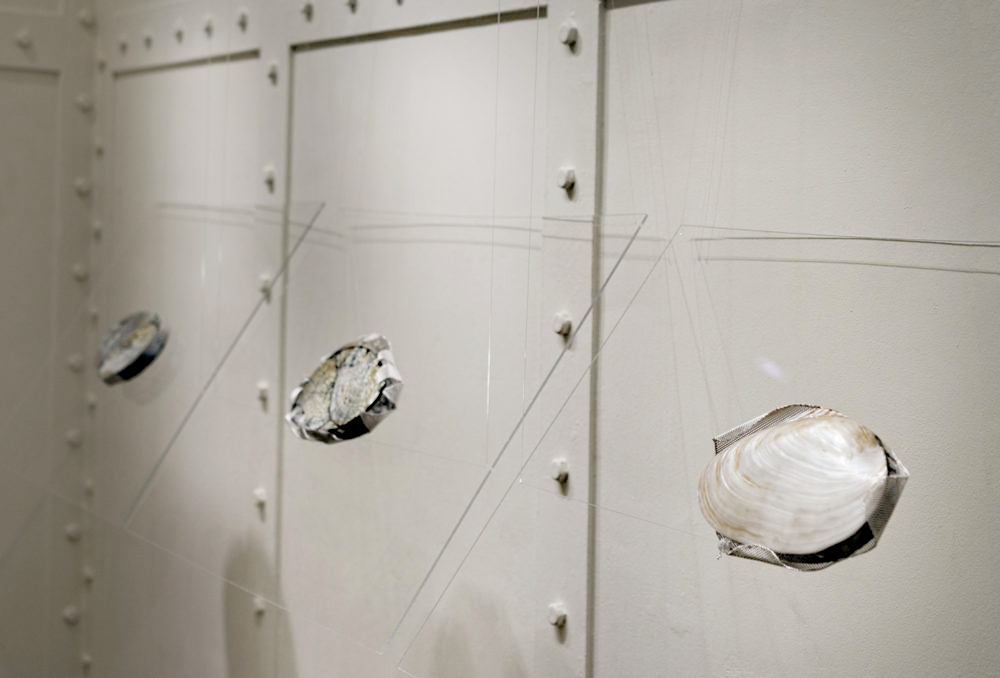
Raili Vinn is mostly known in Estonian art history for using and highlighting limestone as decorative material. Together with geologist and limestone researcher Helle Perens, she has created series of limestone jewellery since 1992, emphasising the diversity of local limestone. Raili Vinn has exceptional knowledge of stone – she has great sensitivity towards stones used in jewellery and she makes her choices with enthusiasm and profound dedication to the material. Perhaps this is the reason why she can shape limestone into jewellery with such mastery – Vinn skilfully makes use of the colour, patterns and fossils in limestone, sourced from various locations and geological strata.
SPELL OF LIMESTONE is Raili Vinn’s sixth exhibition dedicated to limestone.
Raili Vinn (1943) is an Estonian jewellery artist. After graduating from secondary school Vinn studied goldsmithing at ARS Juveel, so it was only natural that she continued her studies at the Metal Art Department at the State Art Institute of the Estonian SSR, which she graduated from in 1969. The following years Vinn spent creating window displays and decorations for Soviet retail and later worked as a graphic designer for Ajakirjanduslevi. She remained active as an artist and was known both in Estonia and elsewhere for her fine and distinguished gold and silver jewellery with a crisp and concrete feel, softened by skilfully chosen precious and semi-precious stones. It was around that time Vinn had her solo exhibitions (1977 and 1987), participated in applied art exhibition of the Estonian SSR, Baltic Applied Art Triennials and international jewellery exhibitions in Jablonec, Czechoslovakia (1984 and 1987). In the last decade of 20th century Vinn was the head artist of Ars Juveel for a short period of time. After Estonia regained independence, Vinn began a new, still ongoing era in her work – with her focus on limestone, she also combines sea shells found on the beach, corals, stones from the sea and other found materials with gold, silver and precious stones.During the past three decades her work has been exhibited both at solo exhibitions in Estonia as well as in Kiel, Berlin, Copenhagen, Krakow and elsewhere. In 1994 she received the Ede Kurrel Prize and her works belong to the collections of Estonian Museum of Applied Art and Design. In 2020 Raili Vinn’s jewellery are exhibited at The Anatomy of Estonian Art Jewellery 1953-2019 at Tartu Art Museum.
HANDFUL OF PRAYERS Hans-Otto Ojaste
HANDFUL OF PRAYERS juxtaposes the movements involved in snacking on sunflower seeds and handling prayer beads. Using fingers to handle prayer beads is used to help with saying prayers and mantras in various religions. Over thousands of years people have developed physical algorithms to code their mind. Fingering beads is synchronised with repeating prayers or mantras.Placing this motif into street culture, one can find a parallel with snacking on sunflower seeds. Just like beads, the seeds are handled with fingers. The movements of removing the seed from its husk and eating it are repetitive. Saying a prayer is replaced by chewing.
Hans-Otto Ojaste graduated from the Department of Jewellery and Blacksmithing at the Estonian Academy of Arts (BA 2012) and belongs to the artist duo Urmas-Ott. He has exhibited in group exhibitions both in Estonia and abroad.
The exhibition of Hans-Otto Ojaste can be viewed in a virtual window here.
REFLECTIONS Katrin Veegen
Dirty sweets.That amazing place through your eyes.Again. The same crap every spring…
The exhibition REFLECTIONS brings together a small selection of recent works by Veegen. The roots of the stories stored in these pieces of jewellery go all the way to the experiential moments created and amplified by nature around us. Some moments are just one-time reflections, some moments are flickers that reproduce themselves. From year to year.
Katrin Veegen is a graduate of the Estonian Academy of Arts (2002) and has spent some time during her studies at the University of Central England (UCE). She has participated at numerous jewelry exhibitions in Estonia, Europe and the US. Katrin Veegen has been awarded the Ede Kurrel Prize, and her exhibition LAURELS was selected as the A-Gallery´s Best Exhibition of the Year in 2007. In 2017, Veegen established her own brand, under which she creates small-scale jewelry series and unique artisan jewellery from her studio at Hobusepea street.
PARTY Kristiina Laurits
“Like food, jewellery has the ability to create the illusion of a full stomach. To be convinced, all you need to do is smell and taste. Pure, symbolic materials, like bread, have always been alluring. Their constantly changing qualities and abilities to change their angles of reflection have always been captivating. My jewellery juggles great narratives like faith, hope and love without shame. And, also suffering is part of this party”. – Kristiina Laurits
Kristiina Laurits studied in Estonian Academy of Arts, department of jewellery and blacksmithing (BA 1997, MA 2003). At the year 2000 she visited the jewellery department of the Escola Massana school in Barcelona. She has participated in more than 80 jewellery exhibitions in Europe, China, USA. Her works are in public collections in Estonia and US. Since 1999 she is a member of Estonian jewellery group Castle in the Air. In 2017 Laurits published the artist book THE HAPPYFEW. Jewellery and Objects. Currently, she works as a freelance artist in Tallinn.
In his first solo exhibition, Edgar Volkov deals with the potential of water to be the bearer of change. While thinking about the surface of water as a border between states of being, he is interested in the experience of encountering the unknown and when the encounter becomes acknowledged as a change. The works he presents are hand engraved silver brooches covered in dark enamel.
“How dark is the water that surrounds us? What lies beneath the surface, in the bottomless dark? Do we dare to take a look? And what will we find when we dip our fingers in the waters? Will we find what’s been lost? And when we get lost and resurface from the depths, will we be the same as we once were?”
Edgar Volkov is a jewellery artist. He graduated from the Estonian Academy of Arts in 2015 specializing in jewelry (BA). He is working at Roman Tavast. He has taken part of group exhibitions Vari at the courtyard of Estonian Academy of Arts (2014), Ferromenaalne at Tallinn City Gallery (2014) and Pinna all at St John’s Almshouse Museum (2016).
Vaida SuitsVaida SuitsMart Kekišev, Kairin KoovitLiina Lelov, Valdek LaurAdolfas Šaulys, Mari Relo-ŠaulysAdolfas Šaulys, Mari Relo-Šaulys
They know themselves, move in parallel, bubble into pink slime and keep on going.
LOVERS areVaida Suits, Mart Kekišev + Kairin Koovit, Liina Lelov + Valdek Laur, Adolfas Šaulys + Mari Relo-Šaulys
FROM TIME TO TIME Vaida Suits
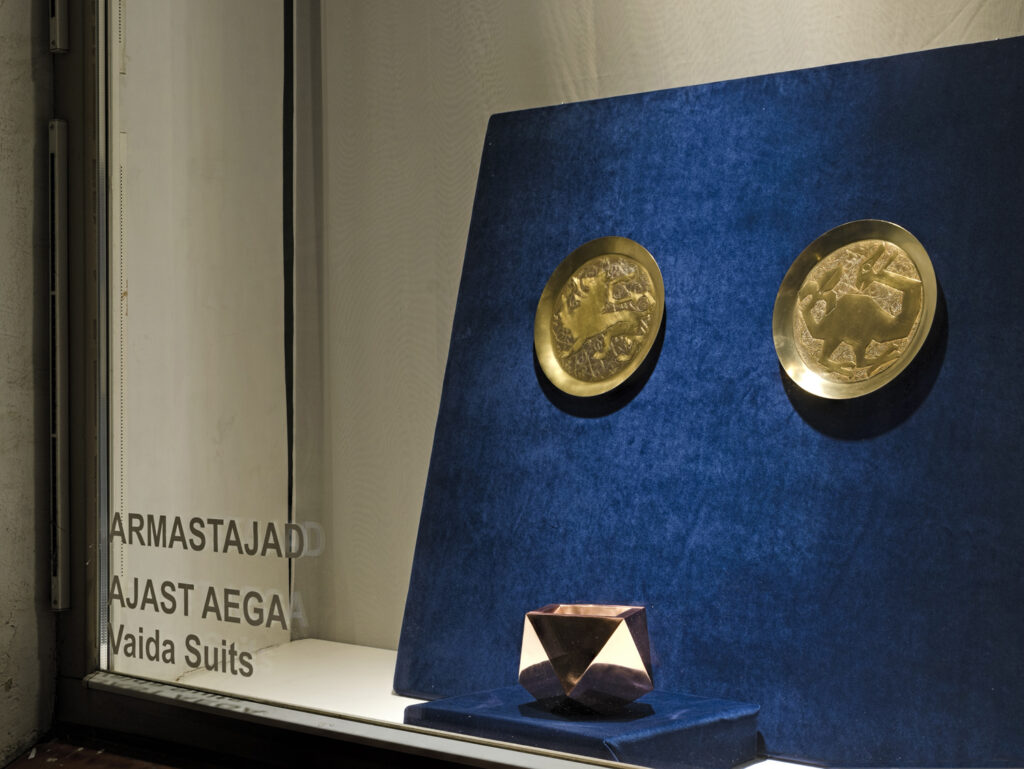
Vaida Suits (b. 1931) is an Estonian metal artist, whose dynamic work is characterised by a labour-intensive process, Art Nouveau forms and extremely fine skills in traditional techniques. Still, her signature style is always clearly defined and even laconic. Suits was the only woman working at the ARS Art Products Factory in steel engraving and later as a designer, creating both unique series as well as extensive commissions for institutions in Estonia and elsewhere in Soviet Union. Working as a jewellery designer at the Tallinn Fashion House her work was well received also in fashion shows in London, an extraordinary achievement for a designer from the Soviet Union. Praised for her impeccable work ethic and an original style, Suits has taken part in exhibitions from the Balkans to Norway and from Italy to Mongolia. Her works are in the collections of the Museum of Decorative, Applied and Folk Art in Moscow and the Estonian Museum of Applied Art and Design.
As a tribute to Vaida Suits’ creative life of more than half a century, A-Gallery is displaying in its two windows rings, bracelets, necklaces and objects created from the 1960s onwards. There are examples of filigree, embossment, and engraving, as well as compositions of various materials.
TOGETHER Mart Kekišev, Kairin Koovit
The material is composed of two elements, joined together and moving in unison, exploring boundaries between two people and possibilities for togetherness. The works are made of Damascus steel and in the mokume-gane technique.
Mart Kekišev studied at the Department of Jewellery and Blacksmithing at the Estonian Academy of Arts. For the last ten years he has worked as a freelance metal artist. For the past five years Kekišev has worked as a blacksmithing teacher in a vocational school. Last autumn he began his Master’s studies at the Department of Jewellery and Blacksmithing at the Estonian Academy of Arts.
Kairin Koovit studied at the Department of Jewellery and Blacksmithing at the Estonian Academy of Arts. She has participated in exhibitions both in Estonia and internationally. Koovit has been an intern at Peter de Wit’s and Margareth Sandström’s studio. In 2011 she received the Roman Tavast Young Jewellery Artist Stipend and since 2012 works as artist and designer at Roman Tavast.
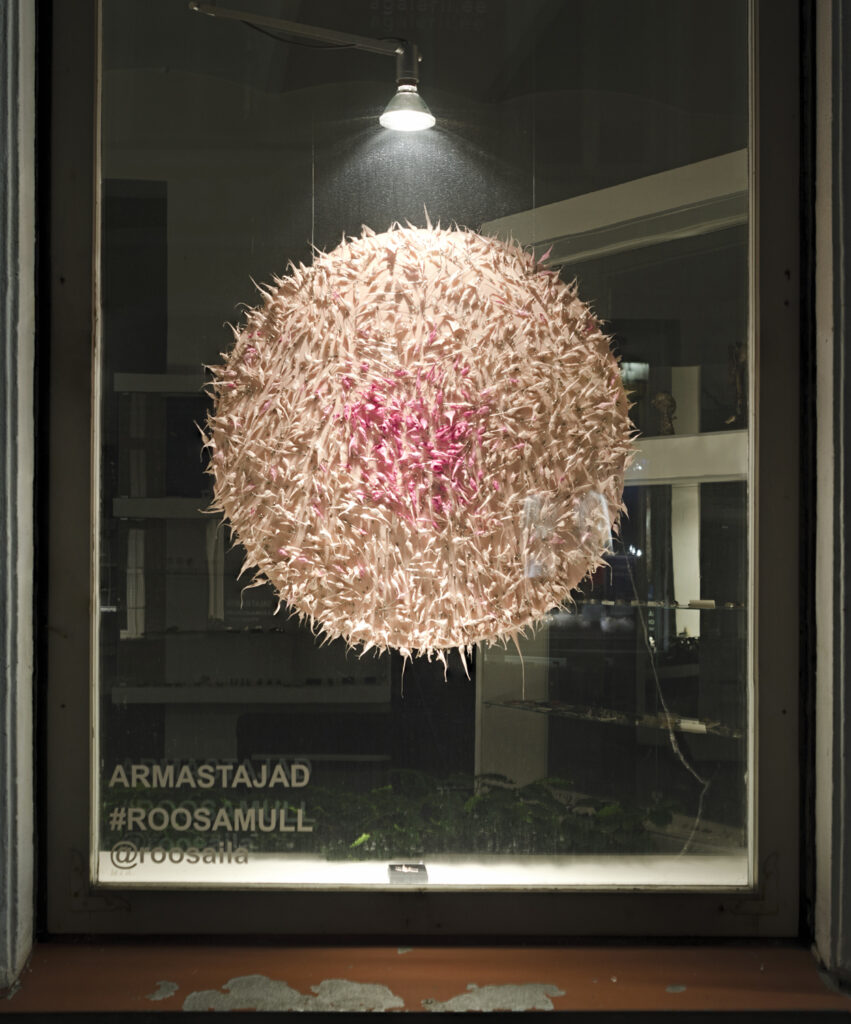
Pink bubble oozes both pink spittle and pink slime – everything that is kind-hearted, tolerant and happy. Pink spittle has always existed, but only found its material form in May last year, when it became necessary to remind people that there is nothing wrong with living in a pink bubble. And so, the meaning of this derogatory term was flipped and converted into something positive and joyful.By now pink spittle has found its way to Sweden, Tunisia and the US, been part of countless protests, conferences, events, and been pinned onto the chests of many prominent suspicious elements.
The window exhibition at A-Gallery concludes the material journey of pink spittle. These are the last of spittles and slimes that ooze into the real world from the pink bubble. It is only appropriate that the symbol’s final presentation takes place in the only art jewellery gallery in Estonia. Very soon, everything goes back to normal again.
Pink spittle is created by jewellery artist Liina Lelov and Valdek Laur, a student at Department of Jewellery and Blacksmithing at the Estonian Academy of Arts.
LIFE 100 Mari Relo-Šaulys, Adolfas Šaulys
“Our good friends noted a few days ago that, our ages combined, we are now 100 years old.A+M=100
The exhibition highlights two significant traits of our joint work. One is exemplified by the socially critical exhibition “Viva la Vida!” (2005), part of our home pharmacies series, and the other by “Kaks õuna” (Two Apples, 2020), commenting on the show “ELU 100″ (LIFE 100), and continuing the tradition of gilding everyday objects”.
“The artists’ first larger joint exhibition „Viva la Vida!“ (2005, A-Gallery, currently Hop) focused on the high number of pharmacies in the city. The artists asked if it is better or even safer to live in a city, where galleries, theatres, cinemas and small businesses are replaced by pharmacies. Does the hope of immortality and taking right pills to alleviate lesser or worse ills makes us happier?” – Ketli Tiitsar
Mari Relo Šaulys and Adolfas Šaulys are Estonian jewellery artists, whose remarkable joint work has been well received both in Estonia and internationally. They have had 15 joint exhibitions and have together received the Ede Kurrel Prize from the Association of Metal Artists of Estonia in 2005, the Annual Award of the Estonian Cultural Endowment in 2010, and A-Gallery’s Vault Room Exhibition Prize in 2015. In 2002 they won the competition “Amber in Interiors” organised by the gallery of the Palanga Amber Museum.
Laos has said that she feels like a child or a god, taking materials apart and rearranging the details to create her own worlds. With DREAMWALK, she is putting the emphasis on her materials of choice – silver, mother of pearl, precious stones and pearls.
“DREAMWALK has two origins. From one end, the splendour and spirituality of Seto brooches, from the other, the utterly irresistible materials such as mother of pearl, rock crystal quartz, silver and steel. Their unison is inviting. The moonlight, woman and the moon are tied for eternity – both carrying fluidity and mystery as their birthright. DREAMWALK is the feeling that moonlight can be pinned to the chest.” – Krista Laos
Krista Laos is a jewellery designer. She has graduated from metalworking at the Estonian Academy of Arts (1978), is a member of the Estonian Artists Association and works at the jewellery design studio Ehtedisain at Katariina Guild since 2000. She has participated in numerous solo and group exhibitions, most notably in Limoges (1990), Cincinnati (1991), Washington (1995), Moscow (1989 and 1993), Beijing (2004) and Berlin (2015). She has taken part of the nomadic exhibition Baltic and Nordic Jewellery Art (Denmark-Finland-Sweden, 1991) and the exhibition Baltic Jewel in Madrid (2004). In 1999, she received the Ede Kurrel prize of the The Estonian Association of Jewellery and Blacksmiths. Her works are part of the collection of the Estonian Museum of Applied Art And Design.
Igor BalašovIgor BalašovAndrei BalašovTea VellerindKertu VellerindKatarina ja Kalle Kotselainen
BALAŠOV x VELLERIND x KOTSELAINEN creates an insight into the transmission of the spirit of metal art between generations on the example of three families. Mother and daughter Tea and Kertu Vellerind, father and son Andrei and Igor Balašov and brother and sister Katarina and Kalle Kotselainen will participate in the exhibition.
“You can’t pass on your knowledge more heartily or passionately than by growing together, playing at the grassroots level. There is something sincere, joyful and reverent in this unconscious transmission of the metal spirit, which infects the following generations with knowledge and creativity,” says A-Gallery gallerist and jewellery artist Marita Lumi about the exhibition.
RELIQUARY Andrei Balašov
“The mini sculptures in the exhibition are made with a principle inspired by the Middle Ages. A reliquary is a thing, a box or an unfolding storage in which very sacred and valuable things are stored. Reliquaries can be found, for example, in Catholic and Orthodox churches. The exhibition presents four silver figures, three of which are reliquaries. The figure of a woman is LILY, or woman as a temptress, the second is WAITING FOR THE SUN with a red stone, and the third is SAINT SEBASTIAN pierced with arrows.”
Andrei Balašov (b. 1965) graduated from Tallinn Art University and improved his education at the Lahti Design Institute. His works have been shown, among others, at the Tallinn Applied Art Triennale, in galleries SOFA (Chicago), Sienna Gallery (Lenox, USA), Galerie Beeld Aambeeld (Enschede, Netherlands), Gallery Chic Choc (Berlin), Gallery Stockgard (Siuntio, Finland) and Estonian Museum of Applied Art and Design.
BORDER POSTS Igor Balašov
“Our understanding of the structure of the world is sometimes beautiful illusion. The metaphor of the cornerstone as an unshakable boundary loses its meaning.
The year was 1990. These works are like a relationship between two countries. Like border posts.
One of the posts has the symbols of one country and graphic details are used, for example, Orthodox symbols and the time of the council. On the other, the Estonian coat of arms and crown – symbols of the republic. “
Igor Balašov (b. 1940 in Russia) is a meritorious Estonian sculptor and member of Estonian Artists’ Association, studied at Estonian Applied Art Institute in 1959-1965. Perhaps his most famous artwork is TELESILM (TV-eye), which decorates the building of Estonian Television. Balašov has also created monumental sculptures elsewhere – his works are in Osaka, Japan, Moscow, Russia, Ukraine and the Netherlands. He has participated in prestigious art fairs and exhibitions all over the world, and his works belong to the collections of prestigious foundations and museums (Estonian Art Museum, Tretyakov Gallery, Pushkin Museum, etc.).
BALANCE Tea Vellerind
“The idea of my works is balance. Since I once wanted to become an architect, I am still interested in the balance of spatial volumes, simplicity and conciseness. Everyone has their golden ratio, and I’m looking for mine.”
Tea Vellerind(b. 1939 in Rakvere) graduated from Estonian Applied Art Institute with a specialization in metal construction. From 1966, she worked as an artist at the Ars-Juveel factory. Tea has participated in numerous individual and group exhibitions both at home and abroad, among others at the Art Salon (today’s Art Building Gallery), Tallinn City Museum, Tampere Art Building Gallery, A-Gallery and Riga Old Town Gallery. She is a member of the Estonian Artists’ Association and a founding member of the jewellery company OÜ Kuldgraal. In 2017, Tea was the laureate of the Ede Kurrel annual award of the Estonian Metal Artists’ Association.
BLOCKHEAD Kertu Vellerind
“My works always have specific titles, because the message in the jewellery is important to me. I enjoy the game with the Estonian language. I interpret this exhibition as a haiku:
vinguv tuul kõle / whining wind desolate sasides aju mõtted peas /ruffle brain thoughts in head mängin keelega / I play with tongue.“
Kertu Vellerind (b. 1967) studied at Estonian Academy of Arts in Metal Department (BA and MA) , at the Lahti Design Institute in Finland and the Drawing Academy of Hanau on the Main in Germany. Kertu has participated in exhibitions both in Estonia and abroad. Since 2016, together with Urve Küttner, she has been a laureate of the Ede Kurrel annual award. In the same year, she was awarded the 3rd place at the Biennale of International Enamel Art in Vilnius, Lithuania. In 2017, Kertu was a nominee of the jewellery competition “Eesti Ehe 2017 – EV 100” organized by the Estonian Gold and Watchmakers’ Union and the laureate of the best annual exhibition 2017 of the A-Gallery.
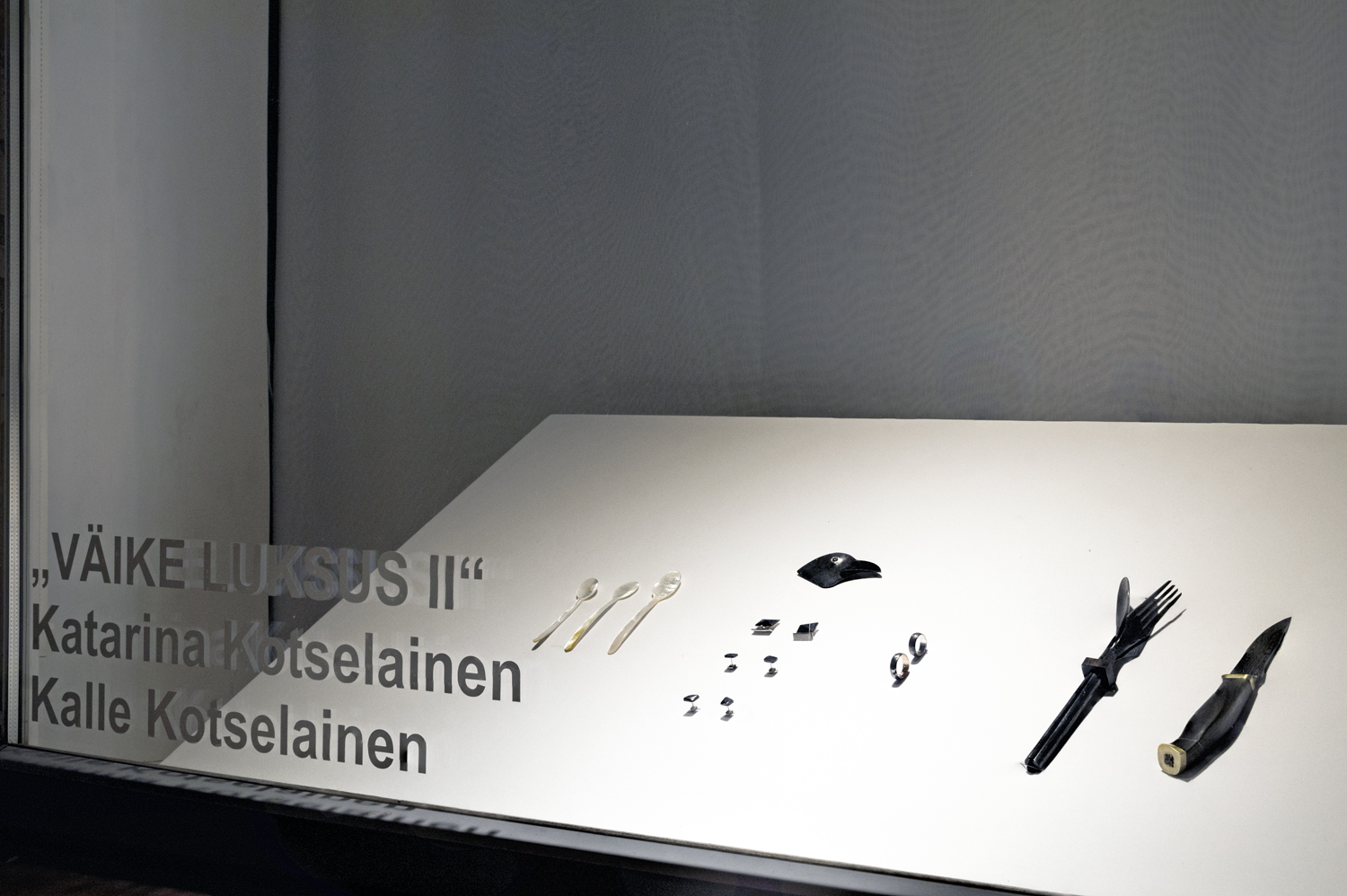
A LITTLE LUXURY II Katarina Kotselainen, Kalle Kotselainen
“We were born into a family where we have always been good at doing things with our hands. Family-wise, I am surrounded by the jewellery mafia, as I jokingly sayto myself, because my boyfriend, father, brother and sister-in-law also make jewellery. I grew up in different cities in Finland, and although traveling is in my blood, I am driven primarily by sentimentality to make jewellery. For me, jewellery is something very personal and associated with memories of people, places and feelings. If my works also evoke positive feelings in the viewer, then I am happy that I have been able to make someone’s day a little bit better.”- Katarina
Katarina Kotselainen (b. 1982 in Tartu) studied at Estonian Academy of Arts (2006 EKA BA, 2010 EKA MA) and improved her education repeatedly in Germany and Norway. Since 2002, Katarina has participated in exhibitions in different parts of the world.
Kalle Kotselainen (b. 1981 in Tartu): “I like the appreciation of the material in damask. By forging different metals together, a unique pattern is born every time. Damascus steel goes well with other metals.” Kalle Kotselainen has been designing and making precious metal jewellery for over ten years. He graduated from Vana-Vigala Technical and Service School blacksmith specialty in 2019.